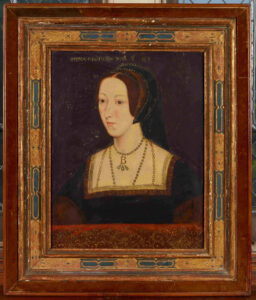
 Thank you to Hever Castle for sending me a press release about this Anne Boleyn portrait, which is part of their “Capturing a Queen” exhibition at the moment. This article is based on that press release…
Visitors to Hever Castle can now view one of the most intriguing and rarely seen portraits of Anne Boleyn.
The so-called Lyndhurst Portrait has travelled from New York to Kent to take its place in Hever Castle’s exhibition, *Capturing a Queen: The Image of Anne Boleyn*. For Anne Boleyn enthusiasts, this is a particularly exciting development, not only because the portrait is seldom displayed, but also because it raises fascinating questions about how Anne’s image was created, copied, adapted, and remembered through the centuries.
The portrait depicts an adult female sitter seated behind a richly embroidered red cushion, her body turned slightly to the left. She wears a black French hood adorned with pearls, along with luxurious black garments decorated with intricate embroidery and blackwork. Around her neck hang several strands of pearls and, most notably, a gold letter “B” pendant suspended from a pearl necklace.
An inscription across the top identifies the sitter as “ANNA REGINA VXOR 2A H 8” – Anne, Queen, second wife of Henry VIII.
That identification alone makes the painting significant, but the portrait’s history and recent conservation work make it even more compelling.
The painting has traditionally been associated with the artist Johannes Corvus, a Flemish-born painter who worked in England during the 1520s. Over the centuries, however, the portrait passed through various collections before eventually becoming part of the Lyndhurst estate in the United States.
Recent research by Anne Boleyn researcher Lee Porritt has shed new light on the portrait’s history. Porritt connected the painting to a photograph taken in 1926 at the Howard Young Gallery in New York. That photograph, now preserved in the Frick Photograph Archive, shows a portrait that closely matches the Lyndhurst panel. The discovery of the painting’s original purchase receipt has now confirmed that the Lyndhurst Portrait is indeed the same work shown in that historic photograph.
Before being displayed at Hever Castle, the painting underwent extensive conservation treatment. Conservators discovered evidence of several aggressive restoration attempts carried out in the past, including overpainting on the sitter’s hair and background. The careful removal of these later additions has revealed a portrait much closer to its earlier appearance and one that bears an even stronger resemblance to the painting seen in the 1926 photograph.
For many visitors, one of the most striking aspects of the Lyndhurst Portrait will be its similarity to other familiar depictions of Anne Boleyn, particularly the famous Hever Rose Portrait.
The facial features, pose, costume, pearl jewellery, and distinctive “B” pendant all invite comparison. Yet rather than proving that either portrait represents a definitive likeness of Anne, these similarities may instead demonstrate the development of a visual tradition surrounding her image.
This is one of the themes at the heart of the “Capturing a Queen” exhibition.
When we look at portraits of Anne Boleyn today, we often find ourselves asking a simple question: “Is this what Anne really looked like?” Unfortunately, the answer is rarely straightforward as no undisputed contemporary portrait of Anne survives, only the 1534 Moost Happi medal. Instead, we are left with copies, adaptations, and later interpretations that often borrow elements from one another.
The recurring motifs seen in Anne’s portraits – the French hood, the pearls, the elegant profile, and the famous “B” necklace – became part of an artistic language through which generations sought to represent England’s most famous queen consort. These visual clues helped viewers identify Anne, even if they did not necessarily preserve her exact appearance.
That is what makes the Lyndhurst Portrait so fascinating. It is not simply a portrait of Anne Boleyn. It is also part of the long story of how Anne has been remembered, reimagined, and reconstructed over nearly five centuries.
And where better to contemplate that story than Hever Castle, Anne’s childhood home?
The “Capturing a Queen: The Image of Anne Boleyn” exhibition brings together portraits and artistic interpretations spanning centuries, allowing visitors to explore the evolution of Anne’s image and legacy. The arrival of the Lyndhurst Portrait adds an important and thought-provoking piece to that story.
The exhibition is included with castle admission and runs until 1 January 2027.
For anyone with an interest in Anne Boleyn, Tudor portraiture, or the enduring power of historical memory, this rare loan is certainly worth seeing.
Find out more about visiting Hever Castle at https://www.hevercastle.co.uk/