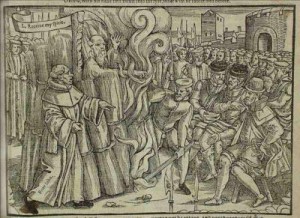
On this day in history, 21st March 1556, Archbishop Thomas Cranmer was burnt at the stake in Oxford. His crimes: heresy and treason. You can read the full details of Thomas Cranmer’s life and downfall in my 2 part series – The Life of Archbishop Thomas Cranmer and The Execution of Thomas Cranmer – but here is a brief account of Cranmer’s last days.
Arrest and Imprisonment
Thomas Cranmer was found guilty of treason and condemned to death on the 13th November 1553 and imprisoned in Bocardo Prison, Oxford, with Hugh Latimer and Nicholas Ridley. All three men were tried for heresy on the 12th September 1555 and Ridley and Latimer, who were found guilty at the trial, were burned at the stake on the 16th October 1555 in Oxford. Cranmer, as Archbishop, had to wait for a decision from Rome as to the verdict. In December 1555, Rome sent its decision – he lost his office of archbishop and permission was given for secular authorities to rule on Cranmer’s fate.
In an effort to save himself, Cranmer made four recantation in January and February 1556. In these recantations, he submitted himself to his monarch, Mary I, and recognised the Pope as Head of the Church. However, Edmund Bonner, Bishop of London, was not convinced by Cranmer’s recantation so his priesthood was taken away and it was decided that he would be executed for heresy on the 7th March. A desperate Cranmer then made a fifth recantation in which he stated that he fully accepted Catholic theology and that there was no salvation to be found outside of the Catholic Church. He repudiated his Protestant theology and affirmed that he was returning to the Catholic Church. He took part in the mass and asked for sacramental absolution.
This should have been the end of it. Cranmer had fully recanted, he had done what Mary I wanted and in a very public way. He should have been absolved but although his execution was postponed temporarily Mary I then set a date for it: 21st March 1556. His recantations were for nothing.
Thomas Cranmer’s Execution
On the 21st March 1556, the day of his execution, Thomas Cranmer was told to make a final public recantation at the University Church, Oxford. He stood up, gave the expected prayer and exhortation to obey the King and Queen and then, in a final act of defiance, renounced his previous recantations, saying:-
“And now I come to the great thing which so much troubleth my conscience, more than any thing that ever I did or said in my whole life, and that is the setting abroad of a writing contrary to the truth, which now here I renounce and refuse, as things written with my hand contrary to the truth which I thought in my heart, and written for fear of death, and to save my life, if it might be; and that is, all such bills or papers which I have written or signed with my hand since my degradation, wherein I have written many things untrue. And forasmuch as my hand hath offended, writing contrary to my heart, therefore my hand shall first be punished; for when I come to the fire, it shall first be burned.
And as for the Pope, I refuse him as Christ’s enemy, and antichrist, with all his false doctrine.
And as for the sacrament, I believe as I have taught in my book against the bishop of Winchester, which my book teacheth so true a doctrine of the sacrament, that it shall stand in the last day before the judgment of God, where the papistical doctrines contrary thereto shall be ashamed to show their face.”
It was a shocking turnaround but Cranmer had nothing to lose. He was going to die whatever his actions and beliefs. John Foxe, author of “Actes and Monuments” (“Foxe’s Book of Martyrs”), wrote of Thomas Cranmer’s execution:-
“With thoughts intent upon a far higher object than the empty threats of man, he reached the spot dyed with the blood of Ridley and Latimer. There he knelt for a short time in earnest devotion, and then arose, that he might undress and prepare for the fire. Two friars who had been parties in prevailing upon him to abjure, now endeavoured to draw him off again from the truth, but he was steadfast and immoveable in what he had just professed, and before publicly taught. A chain was provided to bind him to the stake, and after it had tightly encircled him, fire was put to the fuel, and the flames began soon to ascend. Then were the glorious sentiments of the martyr made manifest;—then it was, that stretching out his right hand, he held it unshrinkingly in the fire till it was burnt to a cinder, even before his body was injured, frequently exclaiming, “This unworthy right hand!” Apparently insensible of pain, with a countenance of venerable resignation, and eyes directed to Him for whose cause he suffered, he continued, like St. Stephen, to say, “Lord Jesus receive my spirit!” till the fury of the flames terminated his powers of utterance and existence. He closed a life of high sublunary elevation, of constant uneasiness, and of glorious martyrdom, on March 21, 1556.”
Thomas Cranmer’s execution should never have happened, it was unlawful. Thomas Cranmer had obeyed Mary I and had recanted and repented of his Protestant beliefs. He had accepted the authority of his monarch and the Pope. Whatever he felt inside, he had signed his recantations and submitted to the Queen and Church. Why then was this broken man, a man who had turned his back on his real beliefs and convictions, executed?
Well, I discussed this in my previous article on Thomas Cranmer and listed the following as possible reasons:-
- Revenge – Did Mary I punish Cranmer for ending her parents’ marriage, making her illegitimate and for heralding in the English Reformation?
- An example – Was his brutal end simply a way of showing how far Mary I and the Catholic Church would go to stamp out heresy?
- Politics – Was Thomas Cranmer simply too influential and important a man to let live?
- Theology – Was Mary I simply doing her duty to her God and country by getting rid of an outspoken heretic?
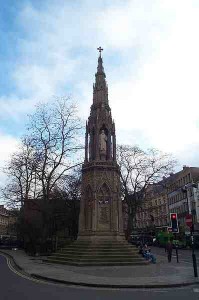
Whatever the reasons for the burning of Thomas Cranmer, he was not forgotten and ended up being remembered as a Protestant Martyr with the likes of Latimer and Ridley. Today, tourists and visitors can see Martyrs’ Memorial and also the cross on the road which marks the site where Cranmer, Latimer and Ridley were burned at the stake. The inscription on the memorial reads:-
“To the Glory of God, and in grateful commemoration of His servants, Thomas Cranmer, Nicholas Ridley, Hugh Latimer, Prelates of the Church of England, who near this spot yielded their bodies to be burned, bearing witness to the sacred truths which they had affirmed and maintained against the errors of the Church of Rome, and rejoicing that to them it was given not only to believe in Christ, but also to suffer for His sake; this monument was erected by public subscription in the year of our Lord God, MDCCCXLI”
Like the apostle, Peter, Cranmer betrayed his faith in fear, but then showed great courage and conviction at the end. RIP Thomas Cranmer.
Notes and Sources
- Foxe’s Book of Martyrs, p236 Chapter on Archbishop Cranmer
- Wikipedia article on the life of Thomas Cranmer
- Wikipedia page on Martyrs’ Memorial, Oxford
I think Cranmer was executed because Mary never forgot that he is the one who declared her mother’s marriage void and this made her a bastard. I think she hated him for it and was happy to have an excuse to execute him in the most horrible way. Burning! I hate to think of it. Mary could be kind but not when it came to anyone who she thought mistreated her mother. Plus, she was such a staunch Catholic she had to get rid of a major archtect of the Anglican Church. I think she had a mean streak!
Ms. Barnhill do you think that Mary I might have been suffering from mental illness. She could not carry a child to birth and thought the tumor she had proved she was pregnant?
The revenge or unhappiness over the divorce of her mother to Henry VIII. Watching her mother suffer from physical illness and separation from the court. The unwillingness of being a Tudor and a Catholic, did Mary I not perceive or understand the English distaste for being told how English should live by an outsider with power such as the Pope. Everything around Mary was changing, people were looking for the new religion.
With the Boleyns and Cranmer group, money was sent to educate girls and boys in small ?schools? This gave the movement that started through Henry VIII a voice and strength that the Catholic Queen could not allow.
To execute Cranmner, Mary I was following the advice of her counselors in the court. Why not execute Elizabeth Tudor? I only wondered this about Mary’s instability becoming queen after her childhood terrors??? ATK
I, for one, am firmly convinced that Mary I had Cranmer executed out of revenge. If she had wanted to subjugate him, and to have the satisfaction of seeing him cower to her will, she would have accepted his recantations. I think Mary I held an unconscionable grudge, and it led directly to Cranmer’s awful, pitiful execution as a feeble old man.
Since Cranmer was also convicted of treason, he could have been executed horribly (by hanging, drawing and quartering) despite his recantations, since recanting only blocked execution for heresy. While I agree that Mary would have wanted revenge against him for annulling her parents’ marriage, I am not sure if this made a heresy conviction (and a burning) necessary, as opposed to the (legally permissible) execution for treason. Maybe, Cranmer’s status as a founder/architect of the Church of England was the reason why Mary went for heresy?
I think several factors came together to form the reason Thomas Cranmer was executed. First, I do think Mary harbored great anger and resentment against him, although she would not have admitted this to herself. I think she saw him as the implacable enemy of her mother and herself, and I think her animus toward him is the main reason he died. Certainly, she could have stopped the execution at any point, and she did not. I also think he was deeply rested by Bishop Stephen Gardiner, who had suffered in the Tower during the Porotestant years, as well as Archbishop Bonner who was a true fanatic. Finally, he had been the head of the Protestant movement in England and had done much to institutionalize and spread the faith. Thomas Cranmer is a hero of mine, and a geat inspiration. He was not naturally a brave man, and faced with a horrible death, he did recant. But he did the right thing in the end, testified to his true beliefs and very bravely held out his hand to the fire.
The man who supported “the whore,” arranged for the divorce and humiliation of her worhty mother, whom Mary never saw again, as well as the marriage of said whore to her father, who then turned her beloved, loving father into a tyrant, and herself into a bastard – yes, Mary had some baggage.
She was probably also rightly suspicious (in her mind) of Cranmer’s recantations of his Protestant leaning beliefs – threatened with burning at the stake, who wouldn’t recant to save his own neck?
As for the Pope stripping him of the title of Archbishop and giving permission to secular authorities to deal with him, it might have encouraged Mary to act against him – Rome, after all, could not have been too happy with the Protestant schism, which it could be argued that Cranmer argued in favor of, leading so many “astray.”
Finally, the political considerations – Cranmer had become quite powerful and influential, thanks to the Boleyn faction, and there was more than one resentful enemy (Gardiner and Bonner, to name only two) who wanted to take him down. Especially since Cranmer was arguably the most powerful member of the Boleyn faction who was left standing in the wake of Anne’s downfall and execution.
So there was a lot of baggage in Cranmer’s execution, legal or not. There was a lot of baggage in Anne’s execution, and a good many people, even some of Anne’s most implacable enemies, like Chapuys, thought the charges against her were suspicious.
Perhaps Cranmer’s execution was Mary’s way of giving Anne Boleyn one last slap in the face.
The very practice of recantation approved by the Church (Papal or Protestant) is, putatively, based on the understanding that a recantation is a realization of its primary intent–to ascertain the change of mind of the person concerned. To doubt a recantation is tantamount to paranoia–a condition in which one is not sure of anything but his/her innate fear of confession of recantation. Contrary to the popular concept of a “Bloody Mary” the legitimate Queen of England (1553-58) was very educated, very religious (well read) woman who had harbored, sadly, a very low opinion of herself. Her only failing (from our vantage point of the 21st century) was that she had no conception of nationalism: hence her loyalty to the Roman Pope and his idiotic Spanish spouse. Her “bizarre” behavior after 1555 coincides with two events: the Treaty of Augsburg and beginnings of the Queen’s temporary “insanity” about her delusional putative pregnancy. I don’t think she was a vengeful monster, witness her clemency for her step sister (daughter of the “whore” who had been responsible for her mother’s painful and baleful divorce masterminded by her lovesick but sexually dubious royal father). Mary was in all probability, not her real self in 1555-57 and gave in to the counsel of his councilors who, admittedly, were Catholic stalwarts. Cranmer was no hero but an authentic human just as Mary was no fiend but a helpless and hapless royal and a homely looking female with very little self-esteem.
People might like to know that every year on the anniversary of the execution, a number of small candles are placed on the cross which marks the site in Broad Street and they are left to burn through the night.
I always found this very touching.
nice.
What a wonderfully Catholic gesture.
Which Cranmer would have hated as papist superstition, bordering on idolatry.
The manner Cranmer went to his death suggest he was much less of a martyr than we think. True martyrs follow Our Lord’s example: Father forgive them they know not what they do. They pray for their enemies – they don’t spit venom and bile at them. St Stephen prayed for his enemies, St Thomas More prayed for his enemies. Cranmer, alas, self-righteously condemned them. St Joan of Arc, who likewise perished in the flames, prayed for her enemies. I’m sorry Cranmer died such a horrible death but I don’t find him a ‘martyr’ at all.
Possibly because of your Catholicism and which Cranmer Cromwell the wonderful Ann Boleyn and Catherine Parr thankful aimed to eradicate from this country !!!
Thomas Cranmer asserted his true self and his true beliefs at the moment of his death after months of being bullied out of them. He also prayed for his salvation. I would being true to yourself, finally, as the most admirable quality you can show.
This is a part of history that is so sad to me. I guess I am too forgiving and do not hold grudges, even against people I know have deliberately hurt me. I leave it up to God to deal with. Religious quarrels which end up in someone being killed just to not make sense to me. This is a part of the Tudor time period that I just can not comprehend and religious quarrels continue to this day. I still do not know why he chose to stay in England. Maybe he overestimated Mary’s ability to forgive.
I personally believe she did it for revenge.
In my opinion Mary was a hateful, bitter person who never forgave anything. She had Crammer executed in revenge for her mother and her life. I think she vowed revenge in the beginning and when she had the opportunity, she acted. Just think what she has to answer to when she stood before God in answer for her life. It is a wonder she did not execute Elizabeth, her half-sister. Too bad England had to put up with her as long as they did.
Elizabeth would also have a lot to answer for on judgement day; the murder of Mary Queen of Scots and many innocent Catholics for one thing. None of these Queens and Kings are innocent of things and will all have a lot to answer for on the day of Judgement as will you and everyone else in the world.
Mary I was revengful and pathetic…
If youd been through what she had been through I am certai you would be the same way.
So is your stupid comment as there is nothing to support it.
I am surprised she didn’t kill her sister Elizabeth. Any ideas as to why she didn’t?
Didn’t she have Lady Jane Gray executed?
Elizabeth was way too popular, and executing her would have led to open revolt. Mary’s husband, Phillip II of Spain was canny enough to recognize this, and talked her out of it.
Elizabeth was hailed as “Born mere English among us” at the time she inherited the throne, and perhaps the growing number of Protestants were viewing the persecutions during Mary’s time as Queen as something “foreign” the Spanish talked Mary into. That Spain had the Inquisition probably did not help matters any.
Mary was reluctant to execute Jane and was pondering her release and pardon until her father engaged in a second rebellion. After that Jane became the focus of an alternative to Tudor rule and too dangerous in the eyes of Mary’s council to be spared any further. Jane had pinched the crown and her fate was in line of those of other deposed monarchs or usurpers, replacement and death. Mary believed that Jane had been the victim of her father’s plotting and was inclined to treat her with mercy. Seven months later the situation had changed and Mary reluctantly agreed to her execution as she had already been condemned.
Elizabeth was a princess of the blood royal and had the same father. She was also being seen as Mary’s heir from the start of the reign. Although Mary saw Elizabeth as politically dangerous which is why she was rightly arrested and taken to the Tower, her role in the plots against Mary were far from proven. Mary unlike former monarchs did not exclude from trials or investigations evidence against the crown and there was some evidence to suggest that Elizabeth used clever arguments to clear her name. Just because Mary had Elizabeth arrested and taken to the Tower does not mean that she intended to have her executed; that is a myth put about by propagandists and Hollywood. She had her questioned and very carefully investigated. She was torn about how to proceed as there was evidence that Elizabeth was involved in Wyatt’s plot. He had written to her and she had destroyed his letters but she did not reveal to the Queen that he had done so and this made her as suspect. Technically Elizabeth was guilty of misprizon of treason that is knowing about it but not revealling it to the state. She stated that she did not approve of Wyatt’s plot and that she was loyal. She wrote a very crafty and intelligent letter to Mary from the Tower and was able to persuade her sister that she was not guilty of the plot. That is why Mary did not have her executed. Also Mary had not produced an heir and Elizabeth was a popular candidate. As a Tudor and a Princess who was well known she was popular, as was Mary. Although Mary had herself declared legitimate and reversed all the laws concerning her parents divorce, she did not do so for Elizabeth and so she could have looked for an alternative candidate. The trouble with this of course is that it would create the same problem as with Jane Grey and Elizabeth would have to raise an army as Mary did and fight for her throne. Mary had the good sense to see this and as Elizabeth was a Tudor she was a better choice for heiress than say Margaret Douglas or someone else unknown. Mary had Elizabeth sent to her house in Hatfield under arrest but Elizabeth also asked for tutors to teach her the Catholic Faith and pretended to be a Catholic. She feigned illness to avoid Mass, but she was also asked to promise to protect and further the Catholic settlement that Mary had given the country. Elizabeth made this promise and on this understanding not only was she pardoned and spared but kept as Mary’s heir and recongised as such when Mary was dying.
I really have no love lost about Cranmer, and I don’t understand why so many other people do. The man was an obvious opportunist and a turncoat. He’d say anything to anyone and knife any person or institution in the back if by doing so it offered him some advantage. He is not the sole person ever executed under bogus charges, nor is Mary I a gross, vindictive monster if she did opt to murder him. By the standards of the time, Cranmer was a traitor.
I have always thought that Cranmerwas one of the few people with real integrity at the Henrican court. He didn’t seek fame and fortune; he was thrust into the limelight because he had a revoutionary idea about obtaining the king’s divorce and the patronage of the Boleyns maintained him there until he had become indispensible. He was the only person (as far as I know) to speak up for Anne to Henry after she was imprisoned.
When, in Henry’s later years, the king told him that his enemies were gathering against him, he was apparently trusting enough to believe that his innocence would save him. Henry was amazed at his naivety.
Although he recanted, hoping to save his life, who among us can swear that we would not do the same under those circumstances? He was only human.
In any case, I could forgive him much for the Book of Common Prayer, which was very much his work and is full of wonderful prose.
I can’t think of Cranmer as a traitor. He had reformist views in the same way as Anne and George Boleyn had. He put into effect those reforms with the knowledge and support of the King. That is not treason. He was no more a traitor than Anne or George. Once Mary came to the throne his views remained the same, but who can blame him for recanting when faced with a dreadful death? I can see the argument for portraying him as a coward, although I personally don’t believe he was, but I can’t see an argument for calling him a traitor.
I agree to that. The persona is too multifacetal to just call him a trator. As for the standards of the time, Shakespeare is closer to Cranmer than we are. Perhaps his “Henry VIII” (http://www.opensourceshakespeare.org/views/plays/characters/charlines.php?CharID=Cranmer&WorkID=henry8&cues=1) helps to understand Cranmer better, even though it’s fiction.
Whoops: Traitor (not trator). I am German, please excuse other possible errors.
What is it someone said about treason? What is treason? Treason is a matter of dates. In Tudor times it could be a matter of religious opinion or the wrong ruler. Cranmer was found guilty of treason because he had supported Queen Jane and he kept on supporting her by writing against the succession of Mary and the Mass, which, although not officially allowed until the Parliament made it legal, had been openly sung for many weeks, by popular demand, because he saw it as a Protestant would, as against God’s word. He wrote tracts which were treason but he remained unmolested, allowed to bury the boy King, but he still wrote against the new Queen. After the second rebellion against Mary he was arrested and tried with Jane and Guildford Dudley and their father, the Duke of Suffolk who was involved in the Wyatt Rebellion. However, Thomas Cranmer had to tried for heresy as well as treason as he had turned the entire country to heresy as Mary and the majority of people would have believed. He appealed to be heard in Rome and his case was sent there. Mary allowed him plenty of time to recant and he didn’t for some time, but he did recant after a time, several times, then changed his mind and he acted to gain access to more favourable conditions. However, in his last few weeks Cranmer made six formal recantations, each to another part of the establishment but his final trial and recanting should have seen him spared even though he was condemned to death, after two trials and a public debate. Mary should have spared him, it is true, but she chose to agree to his execution, for reasons which are controversial and debatable. It wasn’t to her credit, although much of what she did was, but this was a blot on her reputation, even though she was a usually merciful Queen and did pardon several traitors and rebels.
Treason is a matter of dates indeed, because all you had to do in the reign of Elizabeth I was to remain a practicing Catholic, to reconcile someone to the Catholic Faith, to be a Catholic priest or to hide a Catholic priest. Again it was a matter of faith. Thomas Cramner believed sincerely that Jane Grey was the rightful Queen, because she was a legitimate Evangelical granddaughter of the sister of Henry Viii and chosen in the will of King Edward who excluded both sisters, one as Catholic and as he believed illegitimate and the other because she was also illegitimate. Edward named Jane in his will, but Parliament had not met to do this, which was legal protocol, plus it went against the natural order for the succession. Mary had gathered her support and was helped and came to the throne by popular support. She was Queen because she was the true born daughter of Henry Viii and nobody knew who Jane was. Unfortunately, Cranmer was also the man who had turned England and Wales into an Evangelical country, forced the new and unpopular Prayer Book and new ritual with Edward Seymour, who was more moderate than Cranmer and with the encouragement of the young King, but he had a more radical set of reforms in mind, when Edward died. He was seen by the new government as the architect of the new reforms and turning people by force from the truth. This is why two years of education and preaching tiok place to allow time for people to return to the Catholic Faith, before the new laws were enforced on unrepentant heretical followers of the reforms. The burning of anyone was terrible and nobody can and should condone it, but that of Cranmer was one which Mary had rare input into and which could be said to be both personal as well as political.
I find it astonishing that Anglicans and Roman Catholics seem to get along so terribly well today. We can argue about the death of Cramner and the actions of Mary, but we should always remember that that the Protestant Reformation in England was, and still is, a vitally important reality for the freedom and survival of England and the the Englsih speaking world. We should deeply honor Lattimer, Riddly and Cramner as martyrs who preserved Christ-Centered Anglican and Protestant Freedom amid dark and cruel times. We should all be more aggressively involved in preserving our Protestant heritage. Let us thank Elizabeth I for preserving the Anglican Settlement and let us thank Elizabeth II for preserving the throne for Anglican monarchs.
Why?
England has had a longer history as a catholic country than it has as a protestant country, but this will change in time. I think it was John Henry Newman who once said ‘to be deep in history is to cease to be a protestant’
Don´t really know what´s worse: the death for heresy or the death for treason. Anyhow, he managed to stay alive for a long time, which is a accomplishment when you serve a Tudor.
Bishop Bonnor was correct: he had not been sincere in his recantation; you do not just recant to save your life or because you believe that you are doing what the Queen wants; you recant because you personally now believe that you made an error and truly accept the faith of the state to be the true faith. Cranmer clearl was only doing what he believed to be expected of him to save his life. A true martyr would not have stuck to their guns and not accepted anything other than what they truly believed. Cranmer may have acted out of fear rather than cowardice and being made to repeat the repantation five times in public seems over the top; and should have saved his life. It is clear that the state regarded the earlier treason of Thomas Cranmer to support Jane Grey and the fact that he had unlawfully divorced Henry VIII from Mary’s mother Queen Catherine of Aragon as grounds for execution. I do not see it as Mary wanting revenge but to execute a trouble maker. She held Cranmer correctly responsible for the acts that declared her a bastard and she also saw that he was encouraging rebellion as well. She could have tried him for treason and it is odd that she did not, although these charges were also added later. Mary does not act out of revenge; it is not in her nature; she was tolerant to many of her enemies and rebels. But she must have seen some danger in Cranmer and made him as an example as he was politically dangerous as she and the state saw it. Heresy charges were obviously easier to prove and were a bigger coup if he recanted. He did recant and that should have been the last of it; he would have still been imprisoned but not necessarily executed. There are some examples however for some hereitcal leaders not being spared even after confession and recantation as they are persistent offenders and they were strangled instead of being burnt alive. This was the law in Spain. In England this appears to have been different and Cranmer may have spent some years in prison; he would certainly have lost his offices and his status. Why he was executed after all these recantations; four of whom are not volantary but what he was required to do; and they are actually all different with some reasons for them being so. But Cranmer was also a person of influence; so why was his recantation not made to influence others after his public standing? There is a question that many historians may not be able to answer as we cannot get inside the brain of Queen Mary or the state. But I think that he was simply too dangerous to keep alive as he may change his mind publically and encourage others to rebellion or to do the same. In the end; his true feelings were that he did not accept the Catholic faith and he attacked it. So he was not sincere in his recantation and was still a heretic. While no-one deserves to die in that manner; this was the law everywhere and all agreed with it as the price for persistent heretics, Catholic and Protestant alike agreed with it. It may seem horrible to our modern mind and it was; but that was how it was and we do not have a right to judge.
Good points, BanditQueen. But how can a man know if the other is sincere or not? One can only know what the other says or does, but not what he thinks.
You may be right that Mary thought that Cranmer would cause trouble and therefore decided to burn him. But considering the result, was it the right result?
When Cranmer was in prison, he had probably lost his influence among the Protestants because of his apostasy. That would have bee the best situation for Mary.
Now, if Mary wanted to pressure Cranmer to say aloud his true beliefs by putting him in the situation where he had nothing to lose, she succeeded in her aim. But in the same time she lost in a much more important matter. When Cranmer he took back his word, he became to the Protestants a martyr who died for his beliefs.
I wonder if Mary, because of her own strong beliefs, could understand that things she thought best for Catholicism, were in fact beneficial for Protestantism.
There is a too much conjecture and assumption being made as to the mind and will of Mary in having Cranmer executed, as if we have the privilege or gift of reading her thoughts though time separates us from these events by nearly 450 years. Further, we incorrectly judge by today’s standard that which was done by the standards of its day. Regardless of whatever reasons existed in Mary’s mind, two key elements must stand out on their own merit. First, that Mary was Queen, and by law the supreme authority and head of both secular governments and spiritual realms within her kingdom. This was an era in which a state religion held full power over the will and rights of the people. Speaking against Church and Queen was therefore a matter of treason, not simply a protest of one’s own belief. Treason, in virtually all historical periods, was punishable by death. Secondly, Thomas Cranmer died standing up for his heartfelt beliefs that the Catholic Church and its popes were a corrupt version of Christianity that merited complete reformation or utter destruction. The blood of martyrs who died in defense of principles of righteousness and the divine role of Jesus Christ brought forward additional voices willing to make the ultimate sacrifice in Christ’s behalf merit the Kingdom of God according to scripture. Whether his views were perfectly correct or not quite so, yet he lived and died with integrity and honor to those beliefs, and that alone should be an example to us all that true nobility is not a birthright but a matter of right living and a willingness die for the sake of Christ. All other voices clamoring from left or right are nothing more than senseless noise that detracts from the real lessons to be gained by our studies of history and religion.
Just who was Cranmer a traitor to? Cranmer also believed in serving his monarch which is exactly what he did regarding his service to Henry VIII.
There was also a known phrase of Turn or Burn in Marys bid to return England to the Catholic faith which she desired more than anything else, Cranmer recanted so that should have been an end of it, however in Cranmers case Mary chose to go ahead with his execution which I have always believed was nothing but sheer revenge.
The is another side to Mary however which is never really discussed nor acknowledged. Mary was naïve and not surprisingly so. Separated from her mother at a young age, shunned from court and declared a bastard not just by Henry but also by her younger brother Edward. Mary knew very little about the ways of the world as well as the adult world of court. I also believe that once on the throne, there were those who sought revenge against their enemies and used Mary as much as they could to get their way.
Another point often missed is these were dangerous times, especially if you were at court as one could fall out of favour quicker than you could say traitor. There was always someone ready to profit by someone elses downfall and there were many people queuing for some revenge of their own.
Cranmer supported Jane Grey for Queen, so he was a traitor from Mary’s POV.
Treason is a crime that has no objective definition but it is dependent on the ruler, In cases where there are alternatives, he (she) who wins power brands the supporters of his (her) opponents as traitors.
Towards her opponents, Mary was not at all the worst ruler. His grandfather, Henry VII, decided after he had won the crown in Bosworth, to begin his rule before the battle which made traitors men who fought for Richard III.
Towards the “heretics”, Mary was at least consistent. She was a Catholic, so the Protestants were heretics. His father burnt both Catholics and Protestants, and his subjects had to change their beliefs at once when their king changed them.
Don’t forget Mary I was the first daughter of H viii, she inherited the cruelty of her father.
You don’t inherit cruelty, you learn it. Mary was not cruel. She was acting as all monarchy did, as her sister did. I would recommend Anne Whitlock on Mary or Linda Porter or Proffessor Edwards.
The idea that Mary acted out of revenge is too simple and needs challenging. First, there is no evidence to support this, it’s only an assumption based on her known feelings about her parents marriage. We can only speculate on how she personally felt about Cranmer. Cranmer did himself no favours in his own persistently treasonous behaviour. He published letters exhorting the bishops and public to raise up against Mary and to protest against any religious changes before she had uttered a word about religion. When everyone else accepted Mary was now Queen, Cranner refused and persisted in acts of civil disobedience. Even after Mary graciously allowed him to bury Edward in the Protestant manner, Cranmer wrote against the Queen. He had the time and the opportunity to go abroad. So was he inviting trouble?
Probably not, well not in his own eyes, he was being steadfast for his truth. Cranmer, technically should have been executed for treason, but he was now summoned to answer to Rome. He didn’t go in
person but his case was heard there. It was two years of waiting and opportunities to back down that led to him agreeing to everything to gain more favours or visits from his jailers. He wanted to save his life and please his jailers and the authorities. His various recantations should have saved his life, but he had previously acted without sincerity. This was a difficulty when dealing with heretics. Recanting was meant to be sincere and unfortunately for poor Cranmer, the authorities didn’t believe him. In addition, he was still guilty under the law of treason, so recanting may not have saved his life. Even had he lawfully been absolved for heresy it is a real possibility he would have suffered as a traitor. Being a clergyman would not absolve him here either, demoted or not as clergy died under Henry Viii and Cardinal Fisher had been executed. Archbishop Scope had also been executed by Henry iv. I doubt he would be hung drawn and quartered, but he could still have been beheaded.
I don’t know why Mary opted for death as a heretic rather than a traitor, it only gave him a new platform and his public recantation was withdrawn as he no longer had anything to gain. Cranmer, himself believed that heretics should be executed within two weeks of arrest, something the state under Mary didn’t hold with. You had to give people ample opportunity to repent. Cranmer had done this, at least publicly. At the end he stuck to those principles which had brought him to fame as a front runner in the reformation. He declared items of faith he believed to be true and deserves our regard in that and remembrance.
We should not forget any of those who were victims of the Reformation, reformed, Catholic, none conformist, Anabaptist or even those whose beliefs were off the shelf. Shared memorials to all of them around the country show their suffering and bravery. RIP all of the martyrs for religious acceptance and truth or freedoms, men and women, no matter who they are. Amen.
Thank you for the wonderful and varied insights. A wonderful exchange. It is most unfortunate that so many met the end of our short life spans with such violence. May God grant us all a greater ability ad the grace required to love one another. C