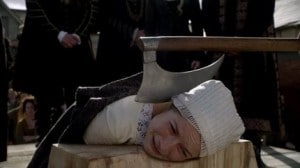
 Today Tudor history lovers everywhere will be remembering the tragic end of Queen Catherine Howard, the fifth wife of Henry VIII who was executed on this day in 1542. Many will not remember that Jane Boleyn, Lady Rochford, was also executed and some will agree with the sentiments of one tumblr “confession” which said “Jane Parker deserved her execution more than any woman Henry VIII put to the block”. She got what was coming to her, karma is a beautiful thing, she deserved it, she betrayed Anne Boleyn, she was a liar…blah, blah blah…
But I, for one, am giving Jane Boleyn the benefit of the doubt. In my opinion, Jane the monster, the liar, the voyeur, the jealous and spiteful cow, belongs to the realm of fiction and should stay there. The real Jane Boleyn is a bit of a mystery but deserves more than to be slandered by people who know nothing about her. Don’t you think?
The Jane Boleyn of History Books
But it’s not just the likes of Philippa Gregory (à la The Other Boleyn Girl and The Boleyn Inheritance) and Michael Hirst (The Tudors) who depict Jane as a “horror” – Philippa Gregory’s words, not mine – historians do too.
In “The Lady in the Tower: The Fall of Anne Boleyn”, Alison Weir writes of how “most sources agree that the only evidence for incest would rest upon the testimony of Jane Parker, Lady Rochford” and that Edward, Lord Herbert of Cherbury, the 17th century biographer, described Jane “as the ‘particular instrument’ in the ruin of her husband and his sister “, basing his account on contemporary evidence: Anthony Anthony’s lost journal. Eustace Chapuys, the imperial ambassador; an anonymous Portuguese account; the writings of Lancelot de Carles, secretary to the French ambassador, and Jane’s execution confession all, according to Weir, back up the fact that Jane was the woman who gave evidence against the Boleyn siblings.
Weir goes on to write of Jane’s jealousy of the close relationship between George and Anne, the unhappiness of her marriage to George, the possibility that George had “subjected Jane to sexual practices that outraged her” and her resentfulness towards Anne over her banishment from court after she plotted with Anne to remove a lady from court, a lady who had caught the King’s eye. These reasons, along with her father’s sympathy with the Lady Mary, could, Weir theorises, have led to Jane’s betrayal of the Boleyns.
Lacey Baldwin Smith, Catherine Howard’s biographer, says of Jane: “the lady was a pathological meddler, with most of the instincts of a procuress who achieves a vicarious pleasure from arranging assignations” and C.Coote said “the infamous lady Rochford… justly deserved her fate for the concern which she had in bringing Anne Boleyn, as well as her own husband, to the block.”
So, people can be forgiven for judging Jane harshly, I suppose, when historians do too.
In Defence of Jane Boleyn
Jane Boleyn is judged harshly because many people believe that she betrayed her husband, George, and her mistress Queen Anne Boleyn by providing Thomas Cromwell with ‘evidence’ of incest. But did Jane betray Anne and George Boleyn?
No, I don’t believe so and I’m not the only one. Historian Julia Fox argues against this fallacy in her book on Jane, calling Jane “a scapegoat”, and her husband, historian John Guy, in a review of Alison Weir’s “The Lady in the Tower”, points out the following:-
- That Chapuys never named Jane Boleyn as the witness against George and Anne
- That the Portuguese source also did not name Jane, writing of only “that person”
- That Lord Herbert of Cherbury was not quoting from Anthony Anthony’s lost chronicle but from his own book
- That Jane’s execution confession was a forgery and the work of Gregorio Leti, a man know for making up stories and inventing sources.
- That Lancelot de Carles was talking about Lady Worcester, not Jane Boleyn
But what about George Boleyn’s own words at his trial? I hear you ask. Yes, at his trial, George, according to Lancelot de Carles, said:-
“On the evidence of only one woman you are willing to believe this great evil of me, and on the basis of her allegations you are deciding my judgement.”
But he doesn’t say “On the evidence of my own wife you are willing…”, does he? He says “one woman” and seeing as it was the Countess of Worcester’s conversation with her brother, regarding the Queen’s inappropriate relationship with her brother, that was the Crown’s main piece of evidence, then surely he was referring to her. When Jane wrote words of comfort to George in the Tower, he didn’t throw a hissy fit and write back telling her to go to hell, he sent his thanks. OK, he wouldn’t have known at that time that she had given evidence against him, but would she have dared to write to him if she had? Hmmm…
We have no concrete evidence that Jane did betray George and Anne or that she was the sort of woman who spied through keyholes and lied, and I don’t feel that we can question depictions of George and Anne without questioning those of Jane. She deserves to be defended too, I feel.
Jane Boleyn and Catherine Howard
But what about Catherine Howard? What on earth was Jane doing becoming involved in Catherine Howard’s adulterous liaisons with Thomas Culpeper? How can we defend her actions in 1541?
Well, I had a discussion with Julia Fox about Jane’s involvement in Catherine’s affair with Culpeper and Julia said that she had considered various theories but had ruled all of them out bar one. Jane didn’t need any money, she had been left well provided for by Thomas Boleyn, so she didn’t need any monetary persuasion to help the couple. There is no evidence that she was mad prior to her imprisonment in the Tower so it was not madness which drove her to recklessly help the couple betray the King. Julia Fox believes, therefore, that she was persuaded to help Catherine once and that she was then on a slippery slope heading in one direction. She’d done it once, so could not refuse again. We also have to take into account that Thomas Cromwell, the man who had helped her in the past, was dead and gone so she had nobody to turn to, nobody to confide in and to act as a go-between between her and the King. Jane was on her own with a dreadful secret which could cost her her head and she didn’t know what else to do apart from carry on helping Catherine and Culpeper. She had already incriminated herself so it got harder and harder to back out, so, instead, she just carried on and ended up digging her own grave.
Jane may have been guilty of stupidity, in not learning from what happened to Anne Boleyn and the five men in 1536, she may have been guilty of giving Cromwell evidence that Anne had spoken to her of the King’s impotence, but she was simply being honest. Anne confiding in Jane, and Jane passing the information on to her husband, speaks clearly of a close relationship between the three of them, not distance and jealousy.
We quite rightly defend Anne Boleyn and George Boleyn against those who have maligned them but isn’t it time we defended Jane too?
What do you think? Please comment and let me know.
You can read more about Jane Boleyn in Julia Fox’s article “Jane Boleyn: The Infamous Lady Rochford”.
Notes and Sources
- The Lady in the Tower: The Fall of Anne Boleyn, Alison Weir
- Catherine Howard:The Queen Whose Adulteries Made a Fool of Henry VIII, Lacey Baldwin Smith
- The Lady in the Tower: The Fall of Anne Boleyn by Alison Weir – a Sunday Times Review by John Guy
- Jane Boleyn: The True Story of the Infamous Lady Rochford by Julia Fox
- The Other Boleyn Girl, Philippa Gregory
- The Boleyn Inheritance, Philippa Gregory
- The Tudors, Showtime, written by Michael Hirst
After reading your evidence, I am inclined to believe that Jane’s involvement in the fall of the Boleyns has been grossly exaggerated. It does seem that the Lady Worcester played a more influential part in their demise as opposed to Jane, and Claire, you’re right – people are very much influenced by what is written in popular fiction. Besides, Gregory has come up with numerous scandalous ideas in her novels, so surely this portrayal of Jane shouldn’t come as a surprise!
However, I don’t really feel one can disagree with Denny’s description of Jane as ‘strange’. I think it’s extremely difficult to uncover what really occurred in the Katherine Howard episode, whether it was the Queen forcing Jane to act as a go-between, or, Jane was persuading Katherine to see Culpepper. Personally, I believe Lady Rochford influenced the young Queen to see Culpepper; of course, it is possible that Katherine desired to see him herself, and from her letter she undoubtedly did; yet, to me it is surely worth noting that Jane Boleyn was very much aware, much more so than any of the Queen’s other ladies, of the dangers a queen invoked by being too close to male company, and therefore I believe she must have encouraged, or at the very least condoned, Katherine’s adultery.
Although I also feel irritation towards Gregory numerous times, I can’t help but agree with her theory that Jane encouraged Katherine’s adultery, ‘fully understanding the danger to the young queen’. Katherine comes across as naive, reckless and at times downright stupid, whereas Jane was worldly and wise in terms of the court and its instability.
So.. in a sense, I believe she was probably innocent in terms of her supposed involvement in the fall of the Boleyns, but in the affair of 1541-2, I don’t feel there is any overriding evidence to suggest she was guiltless; in fact, it all convincingly suggests she was guilty of misprision of treason.
Yes, Jane was definitely guilty of misprision of treason, and I’m not defending that, I’m defending her against those who say that she got her come-uppance in 1542 for betraying the Boleyns, which is a widely held belief online.
What she did in 1541 was stupid and reckless, but we can never know the ins-and-outs of what happened. In my opinion, Catherine was influenced by Culpeper, an older man who was guilty of rape and murder, not Jane. Catherine had fallen for Culpeper’s charms when she met him at court while serving Anne of Cleves, so their affair was a continuation of that flirtation. Jane was her confidante rather than the instigator of the affair, I feel, and I can see how something that started off innocently, like Jane carrying a note from the Queen to Culpeper, could have snowballed. Perhaps Jane did try and get out of being involved once she realised what was going on and perhaps Catherine and Culpeper pointed out that she had already carried notes for them and was already involved, that there was no turning back. We cannot know. Jane would have been aware of the dangers, as would Catherine, and she may well have warned the queen. We don’t know and therefore we cannot heap the blame on her shoulders. Just my opinion!
I had not realised he was an older man, I thought he and Katherine were of an age. But a few words of charm can make one do stupid things and Henry was by now Fat, smelly and probably dirty, Katherine was l7yrs old to us a mere girl but not to the medieval period when girls got married as young as 8yrs old.
Henry VIII if he thought she was ‘ a rose without a thorn’ would have been horrified when it was shown she had married Francis when younger, her then being seduced by Culpeper was to add insult to injury. She does seem s bit naïve despite the way way she was ‘brought up’.
It was treason in their day and so the consequences of her actions was beheading.
Maybe Jane was being used again and was involved before she realised how far it would go?
I agree that Jane has been villified hugely by time, history and of course pants historical fiction. If I’m honest, I’m not entirely sure what to think of her.
However, I wouldn’t trust Fox’s book on Jane as far as I could throw it :/ Far too many maybe’s and “Jane would have thought this and done this because she felt like this” – I just thought it was a poor attempt at creating a biography on a woman there is just not enough evidence about. Who knows, maybe one day some more evidence will come to light which will mean a brilliant and well thought out biography can be written about her but not with Fox, in my humble opinion of course 😉
I concur wholeheartedly with Sam. I am personally unsure what to believe about Jane’s personality based on the existing (or non-existing) evidence. But I will say these two things. First, most psychologists tell us that the best indicator of future behavior is past behavior. That is a two way street. The best indicator of past behavior being future behavior as well. So if we believe she made poor choices in 1541-42, when she presumably was more mature and experienced, then it is not unreasonable that she made poor choices in 1536 too. Second, Julia Fox’s book on Jane Boleyn was the singular most disappointing of the myriad of books I’ve read on Tudor History. It was a sad compilation of guess-work. “Perhaps Jane… maybe Jane… Jane may have… Jane could have… .” That book could have been written as easily about any ‘Jane Doe’ – Perhaps Jane Doe… – Had it been labeled as a piece of historical fiction I would have at least appreciated the effort. As a piece of history, it was a major disappointment that was not strong enough to prop up a table leg, certainly nothing I would consider using as a reference.
Completely agree. Not sure why this book is lauded as anything..
As a 12x distant descendant of Mary Boleyn, Anne’s sister, I have grave reservations about the contents of this book, and all of the guesswork that is proffered as ‘reality.’ …In all of what I’ve read…for “evidence” as to Jane’s 1536 innocence….so far, I’ve not seen anything that I can call……real evidence. Instead, I am left to wonder….who was the “Lady Worcester”? I have NOT seen an actual name attached to that Title….for that time frame….just the reference of a ‘chat’ with her brother…whose name is also not identified.
As for 1542, and solely from the ‘evidence’ provided, I can only surmise that … .Jane may have felt trapped…into complicity…because of her earlier actions or inaction back in 1536. My reasoning is that Queen Catherine HOWARD, was a close cousin of Anne and George. That points to direct knowledge, both public knowledge and hidden reality that only the BOLEYN-HOWARD family would have known. THIS….may have been what was used against Jane….to “assist the two lovers.”
Of course, this is just my own speculation, but human behavior and political intrigues …have not changed in all these centuries… It is what it is, and no more than that.
I don’t think it would be fair to blame Jane for the downfall of Anne and George Boleyn because Henry just clearly wanted rid of Anne, and would have found some other reason to have her executed if adultery wasn’t panning out. I don’t believe for a moment that Henry actually thought Anne had slept with her own brother, although in some film, they showed her almost do exactly that in her desperation to conceive a son..a fictional film, but I suppose they guessed she might have tried just about anything.
It does raise an interesting point, though..Would Anne have slept with someone else if only to conceive a son? It seems..interesting to think, but..we’ll never know.
The charges against her were insane, and they did not even attempt to make them sound credible anyway, so it probably doesn’t matter. Witchcraft, incest, adultery..sounds oddly like what was said about Marie Antoinette. When they wanted someone’s head..they got it, and that was all.
As for Jane helping Catherine Howard..well, did she really, or was she just the closest maid and friend to her and therefore a good scapegoat? She *had* seen what being charged with treason meant firsthand, so it’s hard to believe she would willingly do anything to risk it herself. If she’d been smarter, maybe she should have gone to Henry and told him of what she’d seen or heard, thus removing herself from blame and letting Catherine and Culpeper be the bad guys, or would that have opened her up to counter-accusations from them? SO hard to say!
I could see where she may have felt forced to help Catherine, or even where she may have felt friendly toward her..even feeling sorry that she was married to the then-old/bloated Henry while she was so young and vital still. It’s just hard to think she’d willingly put herself in danger just to let Catherine have an affair. How do we know Catherine didn’t somehow blackmail her into it? Afterall, she was his ‘rose without a thorn’ so had she threatened to say anything bad about Jane to Henry..that would have been a pretty frightening threat. What if Jane had something to do with George’s sentence and confided as much in Catherine? She may have known some of her secrets.
This is all so fascinating precisely because we will never actually know.
And it is easy to sit here in our century and say what someone should have done, isn’t it.
Rachel I love your last sentence. Yes sitting in OUR CENTURY and saying who did what or who was a monster or who was stupid or…. The biggest part of our job is to be understanding towards the life style, believes, fears and superstitions of that time. But not to judge. Who knows if any of us was in any of their shoes even Henry himself what would we have done!!
Exactly! Life was so different then…in ways we couldn’t possibly understand. Judgement isn’t appropriate…but I can’t help but to notice the double standards for women that still exist today. Who was Henry to be mad about the affairs of his wives? He had several affairs…even sired children!!
Some things, I think, get ignored about Jane and the Boleyns. One is that George probably would know that Jane was under a great deal of pressure, and how well she could handle it. Another is that the evidence giving rise to the initial suspicion/investigation doesn’t have to be the same as what Cromwell used at the trial. For example, the Countess of Worcester’s conversation may have given the idea of asking Jane certain questions, such as whether George and Anne spent any time alone together, and once Jane answered “yes”, Cromwell used Jane’s statement at trial — something coming from George’s wife might seem more convincing than something coming from the now-dead initial accuser.
I will admit to having a bias against Jane Parker in the past but after reading your article, I’m rethinking my opinion about her. I agree that I think her role in Anne and George’s fall has been exaggerated and that the hatred towards her is undeserved. Unfortunately, there’s really no way to know exactly what her role was in their downfall and it’s certainly no stretch to imagine Cromwell twisting her statement to fit his own agenda. As for the Katherine Howard situation, I never thought that her motives were malicious. Rather, I always thought that she felt sorry for Katherine and acted out of sympathy. I think she might have felt somewhat safe since the king was older, less mobile and so “in love” with Katherine that she and Katherine could get away with what they were doing. Of course, it was foolish to ever feel safe with Henry VIII and they both learned that lesson the hard way. Another great article Claire!!
First of all let me say how much I like this blog. I think it is made up very well and your articles always include so much backgroung information and a bunch full of sources, Claire, so I used them more than once as a starting point for my own research. Also you are so often addressing subjects, which are ignored by many “Tudor Fans” and I think that’s the case with this article here, too.
So enough of the rambling. XD
I’ve been researching Jane too, mainly her involvement in Annes and Georges death. I can understand all the criticism about Julia Foxs biography of her – there are a lot of what-ifs – but in the end Fox says a lot of true things about the evidence given against Jane. I mean, we have no comtemporary, trustworthy witness for her guilt in the affair around Anne. Yes, she told Cromwell, that Anne had said, that the king was impotent. But in the end that wasn’t the reason for Annes and Georges death! And apart from that we just don’t know, what she said, so it’s just plain stupid to believe, she was the chief witness and responsible for their fall.
(Just my humble opinion, no offence meant)
Thinking of Catherine Howard, I just don’t see, why she would have gone to her and say: “Hey, wouldn’t you like to have an affair? I’d help you, you know.” and then push Catherine Howard to Culpepper. They had flirted before, Henry was a stinky, old man, and Catherine was surely experienced enough to get the idea of an affair herself. In the end, what would Jane have gained from pushing her queen into an affair? I just don’t see it and I never heard an argument, which was convincing enough to explain this.
So, I don’t doubt at all, that she acted as a go-between, but there was surely no need to convince Catherine of beginning an affair.
So yeah, I would love to receive a response. It’s lovely to be able to talk about this topic. Also I’d like to apologise for any mistakes I might have made. English isn’t my mother language, so sometimes that happens. ^^
lg
I’m sure I’m not the person you were hoping to get a reply from
but I just wanted to say I agree too. The only theory that makes sense is that Jane was in over her head before she knew it, either that or indeed she suffered from mental illness. I doubt that the ‘insanity’ ascribed to her after her arrest was anything akin to actual mental illness (which would have been apparent beforehand if so) but was rather an effect of the sheer terror she faced. So my theory is either an underlying mental illness (if the insanity diagnosis was correct) or poor Jane was involved too far before she realized the truth. In terms of mental illness a diagnosis of borderline personality disorder would describe her risk taking, among other possibilities. Of course; we simply cannot know as it appears everyday descriptions of behaviour was not often noted.
By the way; you’d never know English is your second language, as your command of it is superior to most English only speakers! Indeed you put me to shame; I’m afraid English was never my strong point at school
I was a science and maths sort.
I’m happy about every reply, (and abolut every compliment too ^^) so you’re welcome. Anyhow I never had any talent for maths or science at all (which is unfortunate, because I have to do written exams in the former for my graduation), so you’d probably put me to shame there…
Regarding Jane: I totally agree with you about her insanity. Of course she could have suffered from some mental illness. Still, even when you keep in my mind, how scarce the sources about her are, surely there would have been some sign of insanity before? I’m not a psychologist, but her behaviour seems to me as a sign of mental pressure as well, very similar to what happened with Anne, when she was imprisoned in the tower, where she began to laugh hysterically and talk far too much out of nervousness.
Maybe something like that happened to Jane too, when she was interrogated by Cromwell? Not exactly the same, but she could have been in hysterics very well. And she wouldn’t have been asked things like “Has your husband slept with his sister?”. Chapuys noted, that George was condemned on the basis of once having been in Annes chambers a long time, which he certainly was. So if I had been in Janes place I probably would have been unable to measure every question and my answers on how dangerous they are too. For Cromwell probably didn’t give her the time to think a lot.
It’s quite possible that Cromwell did twist Jane’s answers in to his questions in regards to Anne and her brother George and the other men.He probably also twisted the words of others questioned as well.I would assume he must have spoken to her other ladies in waiting as well . The answers maybe hidden deep in some archives in Britan somewhere.
As far as Jane and Catherine,the whole thing may have started out quite innocent.Catherine may have asked her to take a note to Culpepper a few times, and Jane might not have thought much about it at the time.Then maybe she saw something going on between the two,and tried to back out,but couldn’t.Catherine could have threaten her in some way, like “I’m Queen,and you will do as I say or I’llhave your lands or money or whathave you taken away”,we just don’t know. The smart thing to do,was for Jane to go to the Duke of Norfolk,and tell him what was going,and let him try to reign Catherine in,or speak to him and others very close to the king,like the Henry’s confessor, and put her concerns out in the open.It’s possible she might have been locked in the tower for several years,,but she might not have lost her heard.
Maybe in some weird way Henry blamed her for what happend to Anne,and then with Catherine, that was the last straw,and so he had her beheaded.After all, other ladies at court surely must have suspected something was going on.Maybe Catherine tried to get one of them invovled as well,but they somehow managed to get out of it,and so she settled on Jane.If it was blackmail, then maybe Catherine brought up old suspecions about her invovlement in the fall of Anne and George.I don’t think Catherine would hesitate to throw Jane to the wolves to save her own skin, and it’s quite possible she brought this up in her trial. So unless we find new paers buried somewhere in the archives, we will never know why Jane did what she did.
I ALSO THINK THAT HENRY MAY HAVE BLAMED JANE IN SOME WEIRD WAY FOR ANNE’S FATE; I PERSONALLY BELIEVE THAT HENRY NEVER STOPPED LOVING ANNE, DESPITE HIS ACTIONS TO THE CONTRARY. IT IS ALSO NOTABLE THAT HENRY LATER HAD CROMWELL EXECUTED FOR ‘PUSHING ‘ HIM IN TO THE DISASTROUS MARRIAGE TO ANNE OF CLEVES; CROMWELL WAS THE ARCHITECT OF ANNE’S DOWNFALL; DID HENRY ALSO BLAME HIM? jANE PARKER IS AN ENIGMA, AND UNTIL WE KNOW MORE ABOUT HER CHARACTER(IF EVER WE DO), WE CAN ONLY SURMISE. WE HAVE 2 WAYS OF LOOKING AT JANE; SHE WAS INCREDIBLY NAIEVE AND HAS WRONGLY BEEN VILIFIED BY HISTORY. SHE DID NOT MENTION INCEST BETWEEN ANNE AND GEORGE, AND IS MERELY THE SCAPEGOAT, AND AS FOR THE AFFAIR BETWEEN HOWARD AND CULPEPPER, SHE GOT IN TO A SITUATION THAT SHE COULD NOT CONTROL. IN OTHER WORDS, THE WOMAN WAS EXTREMELY STUPID. OR, WE COULD SAY THAT SHE WAS JEALOUS OF THE CLOSENESS HER HANDSOME HUSBAND HAD WITH HIS SISTER AND TOLD EVIL LIES ABOUT THEM. SHE WAS NASTY, VINDICTIVE AND VERY NOSEY; SHE LOVED BEING AT THE CENTRE OF DANGER AND INTRIGUE; THIS IS WHY SHE HELPED KATHERINE HOWARD TO CONDUCT HER AFFAIR WITH CULPEPPER,; JANE BEING SO EMOTIONALLY UNBALANCED THAT SHE DID NOT CARE ABOUT THE DANGER TO HERSELF. AS YOU SAY, UNLESS SOME ARCHIVES PAPERS ARE FOUND, WE WILL PROBABLY NEVER KNOW.
I have to agree with Sam on this one. I think there is too much coincidence in Anne Boleyn making noises about Henry’s impotence, and most certainly with Catherine Howard. I do not believe in coincidence, and along with the explanations of her outrage at George for what he had them do in the bedroom. This is not something that would be taken lightly over 475 years later, and he also touches on the fact that I and many others readers have noted that has more to do with Tudor History than her. Just my humble opionion, once again. Thank you! WilesWales
Hello WilesWales,
I’m puzzled by what you mean by, ‘her outrage at George for what he had them do in the bedroom.’ The idea that George raped and mistreated Jane stems from ‘The Tudors’ and the Weir. There is no evidence whatsoever to support that theory.
Forgive me, but I read that on one of the articles leading up to reading this posting, and you have confirmed my statement on another about Weir, and her sources being questionable. I seem to remember her outrage at what George made her do in the bedroom, and that it was known about the court about it. Forgive me, if the word “rape” was inaccurate. I agree that is most probably is; however, what is published by another article on this site, I do promise to quote the source from which it became from now on. My apologies, once again. Thank you for noting this! WilesWales
Louise is correct, WilesWales. Although Weir accuses George of possible committing sexual acts with Jane which she was not happy with, there is absolutely no evidence for this. We know nothing about their marriage or relationship. Weir really doesn’t like George!
I THINK YOU MAY BE CORRECT IN SURMISING THAT GEORGE BOLEYN MISTREATED JANE IN THE BEDROOM. GEORGE ADMITTED ON THE SCAFFOLD THAT HE WAS A RAPIST; THIS IS A FACT. HE SAID THAT HIS SINS WERE AS MANY AS THE HAIRS ON HIS HEAD, AND THAT HE HAD ‘ FORCED’ WIDOWS. MAYBE HE USED TO RAPE JANE; BUT OF COURSE, WE WILL NEVER KNOW. INTERESTINGLY, GEORGE AGREED ON THE SCAFFOLD WITH HIS SENTENCE, SAYING THAT IT WAS JUSTICE FOR HIS SINS, BUT THAT THE SINS HE WAS ACTUALLY BEING EXECUTED FOR, HE WAS INNOCENT OF……..
George Boleyn did not admit to raping anyone on the scaffold and it was the done thing to say that you were a sinner and deserved your punishment at your execution because of the belief that everyone deserved death due to original sin. The whole “forcing” of widows comes from George Cavendish’s Metrical Visions about the men and their executions and is not a transcript of George’s speech. You can read George’s speech recorded by The Chronicle of Calais, which is similar to the one recorded in the Excerpta Historica, 1831, in a contemporary account by a Portuguese man, at http://www.theanneboleynfiles.com/9699/17-may-1536-the-execution-of-george-boleyn-lord-rochford/
I don’t see any evidence to support the idea that he mistreated Jane or that he raped her.
The conclusion to A. F. Pollard’s 1902 biography of Henry VIII is a good starting point for anyone confused as to why people in Tudor times didn’t their assert their innocence on the scaffold when they were clearly being liquidated on trumped-up charges. Pollard’s book doesn’t appear to be widely read these days, but this is an apt quote from the conclusion:
‘The service of the State tended, indeed, to encroach on the service of God, and to obliterate altogether respect for individual liberty. Wolsey on his deathbed was visited by qualms of conscience but, as a rule, victims to the principle afford, by their dying words, the most striking illustrations of the omnipotence of the idea. Condemned traitors are concerned on the scaffold, not to assert their innocence, but to proclaim their readiness to die as an example of obedience to the law. However unfair the judicial methods of Tudor times may seem to us, the sufferers always thank the King for granting them free trial. Their guilt or innocence is a matter of little moment; the one thing needful is that no doubt should be thrown on the inviolability of the will of the State; and the audience commend them. They are not expected to confess or express contrition, but merely to submit to the decrees of the nation; if they do that, they are said to make a charitable and godly end, and they deserve the respect and sympathy of men; if not, they die uncharitably, and are held up to reprobation.’
I’m not sure that those investigating would have been able to get away with misrepresenting what was said in evidence. Those being interviewed would have realised that the very fact these rumours were being taken seriously coupled with the Queen and her faction’s political isolation meant that Henry was after a guility verdict. They would have wanted to distance themselves from the Boleyn faction and what better way than to help in the investigation against them ? I don’t think that it was Jane who made the allegations of incest. I think she told the only damaging (and likely true) thing she knew which was the converstaion mocking Henry’s sexual performance. (On the subject rather strange that when there were accusations of treason, incest , adultry and witchcraft being thrown about that they should have bothered with this).
I don’t think it was wise to speak about the Kings manhood,that would anger any man,but the King ,he was all about his manhood, bad move. Anything said about the King would surely get back to him,OUPS. Katherine Howard was just a child of all about 15 years and a foolish one at that.Cheating on the King another OUPS,bet she did’nt see that axe comming.She was still old enough to to realize, not to anger or cheat on this King, another blow to Henrys manhood.
For the purpose of exciting Tudor fiction, it is great to look at Jane Parker as the creature phillipa Gregory portrays her to be! However I do think that it is far fetched to assume that Jane was totally to blame for Anne and george’s deaths. Evidence was taken from all different people and twisted so many times. Cromwell obviously had his story before the evidence and twisted the evidence around the preposterous charges against Anne. HOWEVER Jane obviously played a big part in Catherines’ downfall. She knew what would happen if and when they were caught, so she should har known better. But sliding downhill can you stop yourself? To me she also seems a sad woman, who has few friends, no family and it wouldn’t take much to push get over the edge
Over time, through reading more informed books, and of course joining this site, my views on Jane have softened, and see her part in the fall of Anne, if any, as blown out of proportion or unintensional, but… concerning the Catherine Howard saga, I can not seem to make sense of her. She had married into one of the most prominent family of that time, seen their swift downfall and survived it.
She had been at court for long enough to now how the polictics, and the people in it worked, and certainly knew the dangers of upsetting her King. So what was her thinking at this time? was she losing her ‘marbles’, and forgot, or ignored these dangers, and placed herself in a no win situation, or did she just get caught up in the general ‘giddiness’ that seemed to surround Catherine, and get sucked down with her. Whichever it was, she was never going to get out of it with her life, being in such close contact with the Queen it would be hard to believe, even now, that she wasn’t involved to some degree. Guilty by association, is a slim possibility, but highly unlikely.
I suppose at the end of the day, she became yet another victim of the brutality of the men and time she lived in, innocent or guilty, it didn’t seem to matter then, as long as the ‘powers that be’ were satisfied…I guess we will never know.
I have read Julia Fox’s book too, and agree that there are alot of ifs and maybes, but enjoyed reading about Jane in a more possitive light, rather than her usual malevolent portrayal.
I kind of wonder if Jane thought she was helping Katherine Howard if she was involved in their meetings because I believe that Henry VIII wanted a child by Katherine and she found out that he was having problems of impotence.
She was unable to get pregnant by him and thought she might be able to pass off Culpepper’s child as the King’s. I think Jane liked Catherine and thought of herself as a protector, realiizing only too late what madness this whole scenario was.
This, to me, would be the only logical explanation of why she would get involved in this situation and take leave of her senses this way, considering how she knew only too well just how ruthless Henry and his councilors could be in a situation.
If Katherine was able to get pregnant, Henry would have been convinced it was his child since he was so besotted with her and it would have strengthened Katherine’s position, probably guaranteeing her life till the death of the King a few years later.
Maybe Culpepper agreed to do it because he was infatuated with her and lusted after her thinking he might marry her after the King’s death.
The one that really bothers me is Francis Dereham and why he decided to come back to court and risk his life by basically “blackmailing” her for the position of private secretary. He had to have taken complete leave of his senses.
If he had stayed in Ireland and her crimes with Culpepper were discovered, the King probably would have been unable to find him and he would have lived.
I agree about her exaggerated involvement in the fall of the Boleyns, your article about it was very convincing mostly because it was analyzing the primary sources. But I can’t have pity for what she has done later. She was not a novice at the court, she should have known how risky life is there! Why didn’t she learn from the past events? She really didn’t have to pay such high price 🙁
Thank you, Claire, and you are correct, and right as always. I just got in the latest copy of Eric Ives’s, “The Life and Death of Anne Boleyn” beside me as my bible, too. Thank you again!!! WilesWales
I don’t quite know what to make of Jane. We know she at least listened to Anne when she talked about the king’s sexual lacks and I read Anne and George also made fun of the king’s dress and his music and poetry. Did I imagine that? I think I read it somewhere. So, she must have known about that, too. I expect she was terrified when she was questioned and wasn’t thinking clearly about what she said. I doubt she gave any real evidence or even hinted at incest. I think Cromwell probably took what she said and made it fit his case. However, after at was all over, she did receive land and goods after she wrote a letter to Cromwell. I can’t imagine why anyone would have agreed to that unless–perhaps it was to sooth Cromwell’s conscience for robbing her of her husband and livelihood? Or some sort of pay off for her testimony? Who knows? And why she did what she did with Culpepper and C H, I will never figure out. She remains a fascinating, unfathomable character for me. Thanks for the article.
I have always thought that Jane was unjustly blamed for the downfall of her husband and Queen Anne. Whatever one might think of her, one must realize that she was a product of court life. I liked Fox’s works while attending university as a girl nearly 30 years ago. He was one of the few that spoke highly of Anne Boleyn. I once argued against a history professor that his hatred of Jane was unfounded. I do think that she was shrew but had to be to survive court life. Most people havent any idea of the viper pit one had to navigate on a daily basis, not just survive but to keep your wits and retain your head. I do however, believe that in the Catherine Howard affair that Jane was culpable. I do not think that Jane did anything without carrying out its fruition in her mind. Personally, I find her life most tragic. I hardly think that she had one day of joy in her life. We have a metaphor in Oklahoma that I like to use: ( When one lays down with dogs one gets fleas.) That is how I would describe Jane and how such an experienced woman found herself without her head.
Has anyone entertained the idea that maybe Jane was just not the sharpest knife in the drawer? That could also explain George’s apparent lack of interest in her. I can easily see how with the situation with Cromwell could have terrified her, and fearing for her and quite possibly her family (Parker’s) safety, she did what she needed to do in order to save herself. Proof or no. As with what happened with Catherine Howard, and with her previous experiences, it was just foolhardy at best. Maybe she was just not that bright. To have done what she did the second time around is so outrageous and dangerous that I really think she was stupid. She couldn’t have been at court all those years and still have been an innocent or nieve. Sad… yes !
One of the things I don’t understand is if George treated Jane badly in the bedroom how did anyone know? I would expect that well-bred women of the time would hardly complain or talk about what happened in the bedroom to others. A case was being built against Anne and Henry was going to get rid of her one way or another. If Jane did make the statements about Anne and George, could she have been coerced into making them, either by threats or promises? With so many different opinions and views, I doubt we’ll ever really know what happened. While Jane may not have been the brightest light in the chandelier, I don’t think anyone can judge any of the people involved in this. They were really only doing the best they could with the tools they had at the time and playing out their fates.
Exactly, there is no evidence to support the idea that Jane was treated badly or even that they were unhappily married. I think it’s a case of fiction turning into history and people just repeating the idea without questioning it. I knew as soon as I posted about Jane’s execution of Facebook that there’d be comments about karma and there have been already, it’s so sad that Jane gets all the blame for Anne and George, but also for Catherine H.
I can just imagine what will be said about Princess Diana and Prince Charles in a few hundred years, if they are remembered for much at all.
That is so true. Also we forget that Ann was not so innocent herself. Why blame her fall on Jane? Ann was the reason Henry put aside Katherine, beheaded Thomas More, set aside Wolsey ….. And Anne made Henry realize he CAN get rid of his wife one way or another. Again the circumstances and life style and all the other factor of the time being involved but Ann had something to do with all the rumors about her too. How come no one said KoA had an affair? She knew Henrys temper she saw what he did for her with Katherine she should have been more careful with the company of young men she kept. At the end everybody is to blame in one way or another but we never know the truth about everything that went on and everything that happened. Regarding Catherine H, I think she was not so naïve or stupid. She had learned about men and sex long before Henry. I think she was arrogant. She was young and beautiful and knew Henry loved her. So she thought she can do what ever she wants because her husband is old and smelly but crazy in love and he will never find out. Jane got cut in the action and maybe this was her revenge against Henry for taking her husband away.. Again we will never know.
Claire,
Great article! You are totally correct about Jane being a “scapegoat”. I believe that Jane was a victim of the times in which she lived, and it’s just easy/entertaining to villainize her now.
There is no evidence to support Jane’s true personality, demeanor, treatment, or intentions. There is only evidence that Jane, George, and Queen Ann exhibited evidence of a close relationship through their interactions. That is why I believe the ‘evidence’ that Jane is a jealous and calculating woman is rubbish.
Thanks for posting that!
Monica
Well, how I see it is that Jane might have given testimony against Anne and George out of fear. If Lady Worcester or someone questioned at Court could have put out the idea that there was something improper going on between the siblings, who better to ask than George’s wife? Seeing what was going on around her…the arrests, people going to the Tower, Jane was probably scared silly. Even Anne, as courageous as she was, broke down in the Tower, and said things that were twisted and used against her. So I can see Jane as being terrified that she would be next…and possibly ready to answer yes to any leading questions put to her. She could have been threatened…we don’t know. So in this way of looking at it, I can see that Jane MIGHT have given evidence out of sheer fear. We must remember that executions by the axe could sometimes go very wrong. It was not a nice way to die. As to Catherine Howard…well, I just don’t understand Jane’s involvement in this one, unless she was very stupid, or someone had something they used against her. I can’t see anyone who went through the fall of the Boleyns and their faction getting involved in something that Jane knew first hand could bring about Catherine’s destruction, as well as anyone involved with the situation. Her actions in this incident are very puzzling.
I think anyone involved with the Boleyn’s and the Tudors walked a very fine line, all the time. Any word said out of turn, not necessarily meant to imply anything bad, would be twisted and turned until it fit neatly into the Kings’ or his counsels’
plan. Jane probably did not know which way to turn, what to say, what not to say. I believe she truly loved George, but was so completely frustrated with his coldness (if that truly was how he treated her), and just possibly gave up even trying to be a good wife anymore. By the time George and the others were accused, Jane was no doubt at her wits end, KNOWING that the King would have her questioned about certain matters. What on earth was she supposed to do? If she defended George, Anne , and all of the other men, then she may have been looked at as an accomplice in the entire debacle. I cannot imagine being put in such a precarious position. That would drive anyone crazy.
Jane and Catherine were both related to the Howards Jane by marriage (her mother-in-law was a Howard); Catherine by birth.
According to what I have read, it was the Duke of Norfolk who apparently put Catherine into Henry’s path. After all, if Anne became Queen, then surely Catherine could do a better job (not to mention being a bit younger and more pliable). But how much did Catherine know of Anne’s time as Queen?
What about the fact that she never remarried? What is known about the reasons behind that? Wouldn’t that have helped to reestablish her at the court? But, would the fact that her first husband was executed have hampered her?
This is a late reply but here goes. I always felt that Jane helped Katherine Howard cheat on Henry partly b/c she blamed the King for the death of her husband. She had little power in court and it must have (for a time) felt good to know that the man responsible for her husband’s death was being cuckolded by his “rose without a thorn.” Obviously, things got out of hand and we know the “rest of the story”, as the saying goes.
My thoughts too. I am prepard to go out on a limb and turn the whole thing on it head. It is only suppositon that George and Jane had an unhappy mariage. What if the opposite were true, and they were in fact deeply in love and happy together? It may be, as other people have said, that when things started to unravel and she was questioned she inadvertently said somethig that was deliberatly misconstrued ad used against the man she loved. She may have blamed herself, and hated Henry for taking George away from her. If she was indeed emotioally unstable this may have festered and developed ito something pathological. Maybe she wa watching and waiting for her chance to inflict the pain on Hebry that he had caused to her. Catgerine gave her that opportunity. Everyone is saying you would be crazy to take the risks she did, maybe she was, but not in the way we are thinking. Maybe she was so comsumed by the desire for revenge that she was willig to gamble her life. Maybe without George she didnt thnik it was worth much anyway. In this mindset when she stumbled upon Catherie´s infatuation with Culpepper it must have seemed like she was finally being given her chance. Everyone knew the king was beotted, what better way to brig him low? He had destroyed her happines, now it was his turn to feel some of the pain she had carried inside her for years. Far from beig manipulated by Catherine, maybe she wae the one doing the ,manipulation. Totally fabciful , I will freeely admit, but it seems as plausible to me as other explantions. tI would give a reason why she never rearried. Alternatively, a woman perceived to have shopped her first husband may not have been considered a great catch fo someone who prefferred to keep his had on his shoulders. But the idea that she and George actually had a love match is backed by Thomas Boleyn providing for her in his will. If you believed this woman was culpable in the deaths of your children would you leave her a bequest?. If, on the other hand you knew she had been a dutiful and loving wife to your so, and a friend to his sister, you would be inclined to look kindly on her.
I have also thought that maybe she was working to get Katherine pregnant by any means. Had Katherine gotten pregnant by Thomas Culpepper, had a son, and been able to pass it off as the King’s, the Boleyns would have been back in power in court. I think a son by Culpepper would have been healthier than Edward and would have inherited after he died. To the Boleyn’s, this might have been the ultimate revenge.
I do not believe that Jane Rochford was potty as shown in the Tudors. I am not sure that she even claimed to be; but I think the suggestion is that she acted as if she was going mad after the arrest of Queen Katherine and her own imprisonment. This is possible because she may have had a mental breakdown under the stress and strain of her arrest, questioning and her belief that she had been responsible for the betrayal of Katherine and her lovers. Lady Rochford may have felt an overwhelming feeling of guilt and may not have been able to cope. She may have been afraid and distressed and this could have caused some sort of mental stress that showed during her early imprisonment. There seems to be no sign of this at the time of her execution and may-be she became resigned to her fate and accepted what was to happen to her and the Queen; makes her peace and recovers. There is an indication that her prison guards are concerned and that they cannot press her for information and evidence; and may-be she may not be able to be executed as she is not in her right mind. This is not clear; but it is a possibility.
There is no clear identification of Lady Rochford as giving state evidenc against her husband George Boleyn and what was she meant to have known or seen in any event; Anne’s principle ladies are more able to give evidence against her than Lady Rochford. The first accuser named is the Countess of Worcester who has personal reasons for being involved in the accusations against Anne. Do not forget that the ladies and others that were brought to the Tower guardhouse to be questioned by Thomas Cromwell and his cronies are told most likely that if they did not reveal what they knew about their mistress and it was found out later that they can be hung for not revealing her treason and adultery. They were probably frightened into giving false evidence or the so called list of crimes listed at the trial of Anne Boleyn would not have been so detailed. Some of the far fetched details are very aaurcy indeed but they can only have come from the imaginations of her ladies and their fear. Jane Rochford did not reveal anything when she was faced with the truth about Katherine Howard but some historians believe she did accuse her own husband at the time of Anne Boleyn.
Did Jane accuse George of anything? It is not clear and there is little evidence that she knew anything about him and any relationship with Anne or had any reason to accuse Anne. Marriage to George cannot have been the most exciting thing in the world and like many wives at the time she was probably neglected to a certain degree as he would have spent a lot of time away from her and her bed. But most marriages were like that; conventional and official partnerships and people learned to co-exist and make a go of these things; had children and made a home and a way in the world. Jane and George had no children but that may have just been a sad thing and not a reflection on their sex life. I doubt any love was to be found in their marriage but I do not believe that they hated each other either. They were as many couples in Tudor England and it is unlikely that George had a homosexual relationship with Mark Smeaton. Did Jane have a reason to betray George? She may have but there is not enough evidence to name her as an accuser in the case against him and Anne Boleyn.
The more mature Jane Rochford seems to have been a much different proposition and to have been much more independent. Having gained some of her husband’s wealth thanks to the intervention of Thomas Cromwell by 1537 she served in the household’s of Jane Seymour, Anne of Cleves and of course Katherine Howard. She seems to have kept something of a matronly eye on Anne of Cleves asking her for information about if her marriage was consumated and reporting the details back to the King’s household. The role that she had in Katherine’s household was obviously her chief lady and she controlled much of the actions of the other household members. This put her in the position of being able to if the Queen wished to allow men to come to her and leave again without being seen. She could be discreet and she could keep an eye out. This is what she did. She arranged the visits of Culpepper and she tried to make sure that she was not caught.
Jane must have had some sympathy for Katherine and the girl was obviously not content to be with King Henry and not have fun as well. She was foolish in her behaviour although I do not think she was stupid. She knew exactly what she was doing and did not care. She foolishly believed she was not going to get caught and of what the consequences of her actions would be. May-be she believed that Henry was so taken with her that he would automatically forgive her; she concealed her past as she did not see it as mattering. Katherine Howard was not a suitable match for a King; she had no training to be Queen, no preparation and was not born to be Queen. She did not have the intellect to be Queen; and it was only her gentile birth that helped her to perform on key in public. Henry should have made sure that she had some training at least before he married her; and she should have known better than to cheat, but I am not sure that she really cared. Whether or not her early liaisons were abuse or childish play she chose as she grew up to have a relationship of full sexual nature with Francis Dereham and they acted as if they were married by her own words. The girls used to get the key from behind the door and let these young men in and carry on with them having wild parties. She obviously could not reveal this to the King but once married she had a duty to behave herself and she was old enough to know that the law would deal with her harshly if she did not. After all she knew what had happened to her cousin Anne Boleyn and she had served at court under Anne of Cleves; she was not that stupid surely?
I am curious about Jane Boleyn’s execution confession – do we have a credible account of it, or just the one that’s been deemed a forgery?
I have done some looking into primary sources since I’ve started reading Gregory’s books, and it has been difficult to find much on Jane. Then the other day I was watching the special features on The Other Boleyn Girl DVD, and during her biography one of the speakers said that Jane admitted to lying about Anne and George’s incestuous relationship. As I have yet to locate any evidence that even proves it was she who made the accusation, I was wary of the information. (Also because they let the actors comment on the biographies as well as the historians.) Were they referring to that false confession?
Either way I’d like to read anything in Jane’s own words, or as heard by a contemporary.
I too, think Jane was innocent. Like many young, noble women in those times, she was a pawn for her family’s rise to power and favor. I think she felt pressure to say that she saw Anne and George together because everyone knew to give that brat, King Henry exactly what he wanted. She also may have helped Catherine Howard to get a little revenge on Henry for what he did to George and Anne.
I have often wondered if Hane´s moyive for doing what she did with Catherine was revenge too. Much is made of a posibly bad marriage between her and George, but what if it was the opposite and they were actually genuinely in love. If we acceot tat she was not the “one woman” who accused him and Anne, mit may be possible to see her a s woman whose man was taken from her and killed at the behest of the king on trumped up charges. If she was emotionally or mentally unstable, or even if not, this could have festered for years. She may simply have been awaiting an opportunity to make the king suffer in some way, as he had her and George. Then along comes Catherine H, and the old fool is besotted. Jane may have considered the risk worthwhile, may not even have cared about the consequences, just to destroy the king´s happiness in the way that he had destroyed hers. Just a thought.
Also I am sure I read somewhere that there were in fact 2 Thomas Culpeppers at that time, an older and a younger, relationship, if any, unknown. One of them was indeed a rapist, but again unclear which, as it is also unclear which one was involved with Catherine.
I am torn on what to think about jane.
One thing I can’t work out though us the fact she continued to hold a high place at court when virtually every other relation to the boleyn a fell out of favour with Henry, I can’t help but feel she did something drastic to show she was against the boleyns, she was a last in waiting to Jane Seymour so her absence from court was very short considering how close to anne and George she had been, there must have been a big reason why Henry was happy to have her back considering what a reminder she would have been of the 15th may, not enough time had passed for Henry to have forgotten.
As someone who studies British Royalty and those who surround them, this was an interesting tidbit to consider. I do believe she had a problem with the Boleyns but interestingly enough I think her problem was with her father-in-law who used her to spy everywhere for him.
It is Thomas Boleyn we can lay a lot of blame upon for the death of Anne and George–People wanted him out of the King’s good graces and would by any means try to bring him down with his family. Thomas Boleyn was a greedy, selfish man who sacrificed his own children to achieve his ends.
Thanks for the article and links, it brings a fresh view on on Jane Parker who’s been very maligned in fiction and -sad to say- history too. I read Julia Fox’s book on last year and that made me reconsider my judgment on her. I think she may have had some jealousy on her mistress and sister in law, but I don’t think she was power hungry and vengeful, jealous woman nor that she accused George and Anne. George would’ve thrown her words of comfort out the window as they say or sent an angry reply if she had.
It’s so very easy to pass judgment when reading the accounts of Jane and watching movie productions of same. However, we must remember that historians are human and tend to right based upon their own feelings – especially those of actual eye witnesses to the events. Does Jane seem guilty of being a disloyal person out for herself alone? Yes. However, it is not for us to judge – only God!
I will admit that I’m not that knowledgeable about Jane Boleyn outside of how she was depicted in the Tudors & The Other Boleyn Girl so was inclined to accept that she was as devious as depicted. However there was one point in the Tudors show about her which always puzzled me. This was the portrayal of Jane’s liasons with Culpepper. Jane being older and “wiser” than Katherine would lead me to think Jane may have encouraged the Queen’s contact with Culpepper. However, if she were herself having relations with Culpepper why would she want or encourage Katherine to do the same with the same man? Most women who are involved with someone usually don’t encourage other women to go after what they have so this point in the show never made sense to me.
Is there any evidence that Jane was involved with Culpepper or is that mere speculation by the writer/s?
Also just wanted to say how much I enjoy this site. I find the articles interesting and enjoyable and stop by to read often.
Very interesting comments. When I write, I try to see the historical evidence with the scrutiny I used as an attorney. I discount obviously biased accounts, discount testimony obtained under duress, and discount hearsay. In the case of Jane and George, I find no evidence at all. Jane’s testimony was after the arrest of her husband and mistress. With or without torture or the threat, she was under severe duress. Unless she was extremely noble, she would have signed what they put in front of her. As for prosecutorial controls, there were none. Spousal rape was legal and indeed normal at the time, as it was in the US until the 1970’s. Perhaps frowned upon, as were non-traditional intercourse (a bit,) these things were far from rare. Even in this blog I see a huge Puritanical back-read of historical facts. These were not Puritanical times. Is it likely that she said something marginally damning about George? Yes (she got back into Court earlier than most involved with the Boleyns) and no (George thanked her for her letter to him in prison.)
As for Catherine, Jane and Culpepper, we only have the undated letter written in (accepted) Catherine’s hand. It refers to Culpepper visiting when “my Lady Rochford” was present. It is unlikely that Catherine would have refered to Jane this way before she was Queen, but possible. However, the letter itself would have been evidence enough to condemn them all of what they were accused, of and what they admitted and what they were executed for – intent-desire. I have no evidence that this letter was a plant. What they said after arrest, in those times, would have been ANYTHING they were told would save their lives. Culpepper would noit have even been accused had not Dereham have attempted to shift the blame from himself to Thomas. Cranmer’s original intent was to get the Howards out of power by using the pre-contract with Dereham, which despite Catherine’s denial, existed in fact, due to intercourse. What she did with Dereham, considering her extremely low position, as far as a daughter of a poor, younger Howard son goes, is not at all strange or slutty. Yes, she should have wanted to marry a low level nobleman, preferably. She says he raped her the first time, and since she held out against Manox, due to his lowly birth, I can believe it. Men forcing themselves on women is still an issue today, and would have been much more so back then. As for Culpepper possibly being a rapist (there were two Thomas Culpeppers at Court) it was a mere misdeameanor for a nobleman to force a non-virgin commoner in sex. It was common. We can’t back-judge him by our standards.
What seems clear is that Catherine and Culpper were VERY good-looking, and it is highly believable that they got together before her marriage, when she was LIW to Anne of Cleves. These two people were apparently irresistable to everyone who crossed their path (of the opposite sex.) The fact that Lady Rochford never re-married, which she would have done to have children, and her husband’s execution would be no barrier, since she was LIW to Jane Seymour, might imply that she did not want to re-marry. As to why, mistreatment by George or lesbianism should be considered. If she was a lesbian, she may herself have been in love with Catherine. Accepting that Catherine met Culpepper during her Queenship, and possibly had sex with him, with Jane’s knowledge or aid, it is impossible to conceive of why she, Jane, would ever do that. Blackmail, revenge, etc. do not make you risk your life, unless you are mentally unstable. Extremely stupid people do not thrive at Court, like she did. If she were insane or stupid, I do not think it would have gone unreported, or that she would have been LIW to 4 Queens. What remains is that she like/loved Catherine, as a daughter, or as a crush. I think that she saw how unhappy Catherine was in her marriage to Henry, and loved her as an older friend/mother figure (Catherine’s mother died when she was young) and wanted to see Catherine’ happy. The alledged plot by Norfolk to get Catherine pregnant by Culpepper’s child is far-fetched but possible, considering the times.
Correct me if I am wrong as to the true evidence. I know Catherine did not show up at her parliamentary writ of attainder hearing, and that Jane was in no conditon to appear, so there is no sworn testimony. Perhaps they were not really given a chance to appear, or informed of the hearing. They were dead from the time they were accused. Such were the Tudor times.
Do you think that it is possible that she was trying to help Catherine conceive when she helped with their tete=a=tete? This would have only worked if she and the king were “active” during that same timeframe as well, which I am not sure of. One would think that Lady Jane would only take part in such a dangerous liaison, if it had a chance in helping her family’s position.
I don’t have information the way ya’ll do, but I believe there is an in between. Innocent? NO! Mean &Evil? also NO. .Naive? Maybe. Eager for exceptance, love, influence, maybe a little bit of power. yes. She was a Boleyn and she wanted to have everything that entailed. She made incredibly BAD decisions and just kept making them over and over. Did she deserve her fate? NOONE deserves that fate.
What a very interesting discussion this has been from start up to the present date, and I must say it has made me reconsider my long held views about Jane being a bitter viper. But she must have been DAFT to get involved with Catherine and Culpeper at such great personal risk.
I tend to believe the majority held belief that Jane did give evidence against George and Anne. For one, Fox’s book was pretty much a joke, in that it was too full of psycho babble and suppostions. I also tend to distrust revisionist history unless there is compelling reason to do so. But the most compelling reason for me to trust the standard narrative is that Thomas Boleyn had to be forced by Henry to properly support Jane, and Thomas went to the effort to tell Henry that we has doing so only to please his Grace. Obviously, Thomas, who knew what evidence was provided by who, was holding Jane somewhat responsible.
I have no informed opinion….but I always think innocent until proven guilty. And as my mother would have said, “If you haven’t got something nice to say, don’t say it at all.” Give poor Jane a break.
I believe that in the case of Catherine Howard, Jane would’ve been ordered to cover up meetings between Catherine and Culpepper. The Ladies in Waiting wouldn’t have disobeyed their Queen. So I don’t think she’d have much option. In the case of Anne Boleyn I believe Jane’s words would’ve been twisted to suit Cromwell.