December 12: The Pelican Portrait
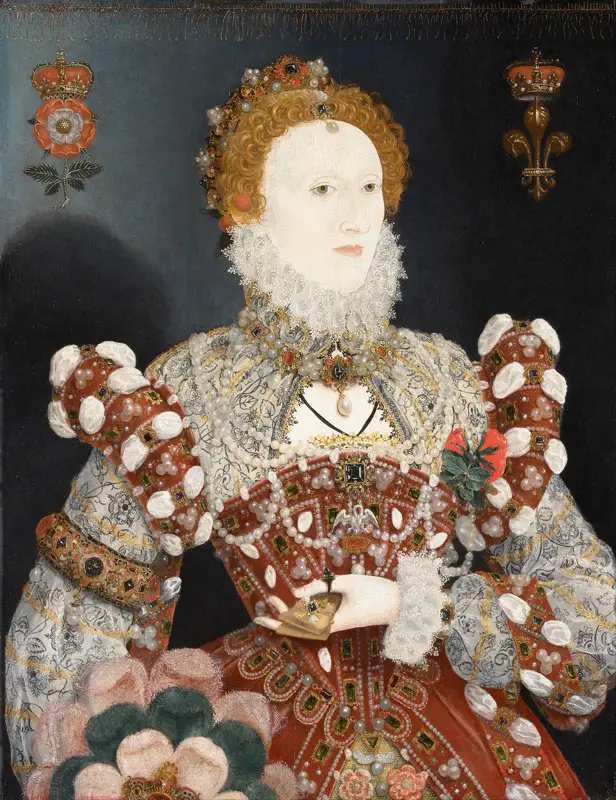
Today's treat is another portrait of Elizabeth I that is full of symbolism. It's the Pelican Portrait, which is thought to have been painted by Nicholas Hilliard in around 1574/1575, when Elizabeth was in her forties. Symbolism in the portrait:
- Two imperial crowns – The crown on the left hand side of the picture is sitting on top of a Tudor rose and therefore symbolises Elizabeth’s claim to England and the crown on the right hand side is sitting on top of a Fleur de Lys and so symbolises Elizabeth’s claim to France.
- The Pelican – Elizabeth is wearing a “pelican in her piety” pendant on her breast and this symbolises her selfless love for her people, a mother’s love, because, according to legend, a female pelican would pluck her own breast to feed her dying young with her own blood. The pelican was also a symbol, in the Middle Ages, of Jesus’ crucifixion, the ultimate sacrifice, and of the Eucharist, the feeding of his followers with his own body and blood.
- The colours of Elizabeth’s clothing – The National Maritime Museum point out that this portrait shows Elizabeth dressed in red, black, white and gold, colours that spoke of her wealth and status. Red fabric was dyed using cochineal, a dye restricted to those with serious money, and black fabric was notoriously expensive.
- Tudor roses – As well as the Tudor Rose in the top right hand corner, you can also see Tudor Roses in the blackwork embroidery on Elizabeth’s sleeves and partlet. Even though Elizabeth has been queen for a while, she is reaffirming her Tudor roots and her right to the English throne.
- Pearls – There are pearls on Elizabeth’s headdress, on her dress, and around her neck and shoulders, lots of them in fact. These symbolised Elizabeth’s purity and virginity. Cherries - A follower of my ElizabethFiles blog noticed the cherries that are hanging over Elizabeth's right ear and which “stand for sweetness and a reward for virtue”.
- The fan – An article on the TES website pointed out that the arrangement of the differently coloured feathers is meant to suggest the Tudor Rose.
- The thornless red rose - An article on the TES website notes that "The thornless red rose on her bodice connotes the Virgin Mary, suggesting that Elizabeth was a virgin queen, married to her country."