Tudor Clothes
The following article is written by Bess Chilver, costumer and Tudor dress expert.
Women’s Dress at the Court of King Henry VIII
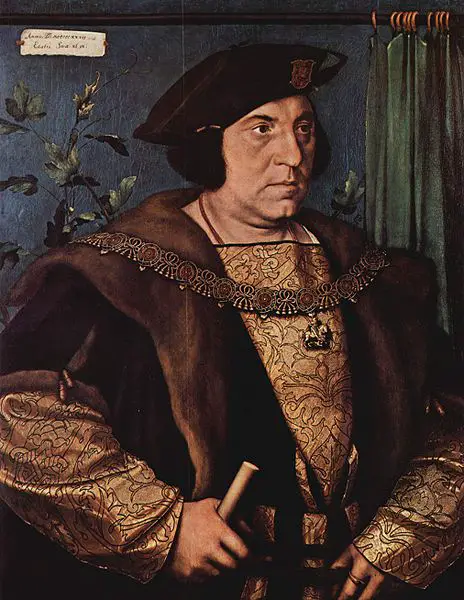
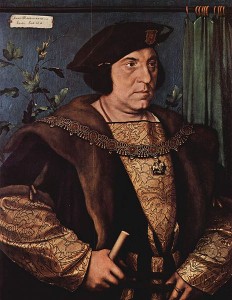
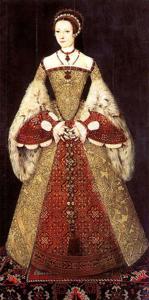
It is without doubt, that the clothing for noble men and women in the reign of King Henry VIII were exquisite. Portraits show a woman’s silhouette is conical in shape whereas the men’s silhouette is wide and square. For both men and women, fabrics are rich and luxurious using sumptuous silks and satins, the finest linens and velvets with abandon.
 |
 |
The fabrics and decorations used are only part of the story. Each garment worn adds to the complete ensemble. To modern eyes, the number of layers worn seem excessive, yet each layer is necessary to the whole.
Tudor Garments
So what are the garments and layers that are worn by women in the Tudor Period? The minimum number of layers actually worn would be four: Smock; Petticoat; Kirtle and Gown. Depending on where within Henry VIII’s reign one was, other layers such as the farthingale, forepart and partlet would also be worn. Headwear would be the finishing touch.
Smock
Smock of fine cambric with wide sleeves, … of fine linen”
25 Jan, 1522/1523 – Lord Monteagle’s Goods.
Letters and Papers, Foreign and Domestic – Henry VIII Vol. 3
Everyone, no matter what their rank, age or sex, would have had enough changes of linen to last at least a week. The higher the rank, the more changes were available. It was a matter of pride to wear clean linens every day.
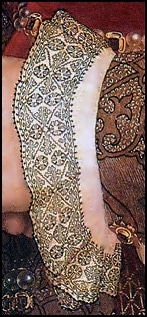
The smock in the upper ranks would be made of very fine linen, as white as possible. The necklines and cuffs could be exquisitely embroidered in black-, red- or white work. Some may have been worked with an early form of lace called drawn threadwork.
In the early part of Tudor period, the neckline was usually square in shape, following the line of the bodice. Later on, a high necked smock was worn which had a small standing collar edged with a frill – this would eventually become the ruff of the Elizabethan era.
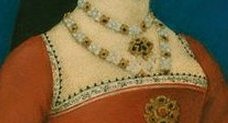
The sleeves would be finished with a small narrow cuff and frill. This, and the neckline, is usually all that can be seen of a smock in contemporary portraiture.
Petticoat
“…a peticoate of scarlet, the upper bodyes of crimson tapheta…”
Royal Wardrobe Accounts of Queen Mary Tudor. 1554.
The term “petticoat” comes from the French for a “little coat” and both men and women wear garments named as such.
For women, it clearly has a skirt and may or may not be upperbodied. Ninya Mikhaila of “The Tudor Tailor” suggests the bodice could be minimal – mostly seen on the back and sides of the body but the front being little more than a pair of “braces” supporting the skirt. This allows for the bare minimum of fabric being used but also minimises the amount of bulk worn beneath the next two layers.
Petticoats are mostly made of a red fabric – red being thought of as a health giving colour. This idea is seen as late as the 19th century.
 |
 |
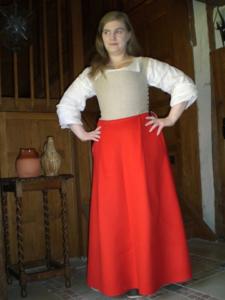
The first image shows my own petticoat made of an unbleached linen bodice which is lined with itself. A fine weight buckram is used to interline the bodice and is supported by boning of cane. Its fastens via laced on both sides. The skirt is a very fine weight scarlet wool. This petticoat essentially doubles as a “petticoat” and “kirtle”.
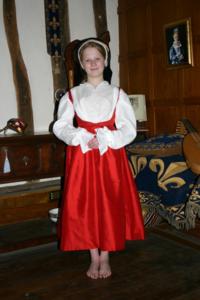
The second image is the petticoat made with the bare minimum required for the bodice. It has a deep “U” neckline. The back neckline is a deep “V” shape. It is fastened at the waist with a laces through a pair of worked eyelets. The skirt is made of a silk dupion and lined with itself. There is a lining of cotton wadding to give the skirt a bit of weight.
Kirtle
“5 yds. of white satin for a kirtle.
2½ yds. of red cloth to line her kirtle.”June 1533. Coronation of Queen Anne Boleyn. Inventory of Apparel.
Letters and Papers, Foreign and Domestic – Henry VIII, Vol 6.
The kirtle was a garment that supported the bust and created the correct silhouette for the period. It was worn over the petticoat, and from the 1540s onwards, over the farthingale. It seems that the kirtle bodice was stiffened in some way, usually with buckram. This was a stiffened linen which may have had additional stiffening consisting of some kind of “boning”. However, it is also clear, that whatever stiffening methods were used, the bodice of the kirtle was not made in the same way as a Victorian or modern corset is. Nor was it designed to cinch in the waist and torso in the same way.
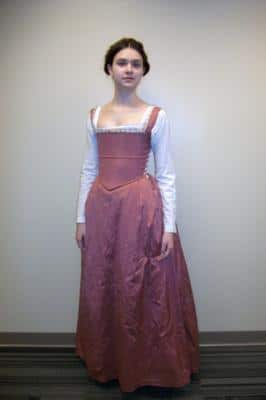
The kirtle depicted above is very similar in construction to my upper bodied petticoat, but is designed to be seen beneath the overgown. It is also side laced and has a stiffened bodice providing a firm foundation for the overgown.
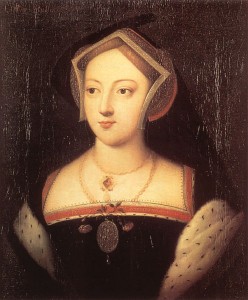
Portraits show a tantalising glimpse of the kirtle – usually at the neckline as can be seen here in Mary Boleyn, Lady Carey’s, portrait:
Gown, Forepart and Foresleeves
“…a gown of right crimson satin, to be lined with cloth of gold of tissue…”
Coronation of Queen Anne Boleyn.
Inventory of Apparel. June 1533.
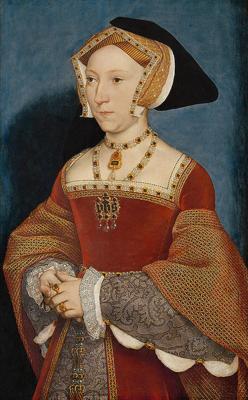
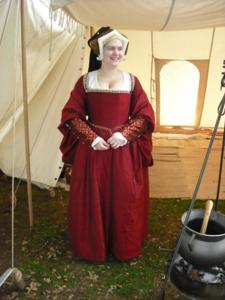
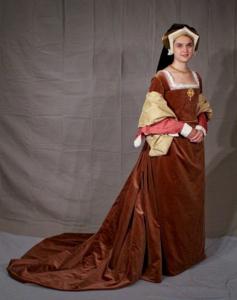
The gown is the garment in Tudor Dress which is seen in its entirety by other people. The Smock and Petticoat are very much underclothes. The kirtle is usually only seen peaking out above the gown neckline so this too is mostly hidden.
As the gown is so visible a garment, it needed to make an impact. This is where sumptuous fabrics could be used such as velvets or damasks or Cloth of Gold. The wealthier a person was or the higher the status, the more sumptuous (and expensive) the fabrics.
 |
 |
Headwear
“And as for Mrs. Anne’s French hood, my lady Sussex had, and Mrs. Katharine gave hers to Mrs. Parr”
28 Jan, 1538 – Lisle Letters. John Husee to Lady Honora Lisle
Letters and Papers, Foreign and Domestic – Henry VIII Vol. 3.
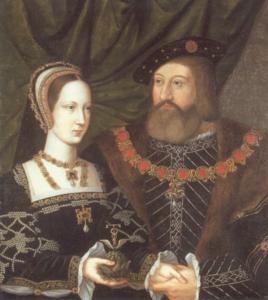
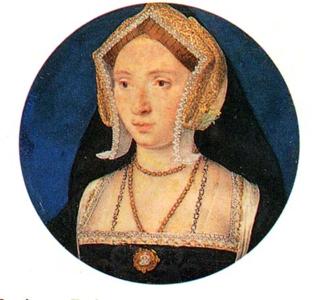
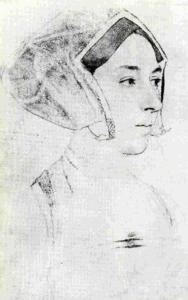
Most people, when thinking about Tudor headwear, will bring to mind, images of two headdresses that were worn during King Henry VIII’s reign. These are the French hood and the English or, as is more commonly termed now, the Gable Hood.
It is a common misconception, that Queen Anne Boleyn was responsible for bringing in the ubiquitous French Hood whereas her predecessor Queen Katherine of Aragon and also Anne’s successor, Queen Jane Seymour, both preferred the English Hood.
Early versions of both forms of hood are seen from the latter part of the 15th century. Katherine of Aragon was painted in version of the French Hood as well as the English Hood, giving the lie to this myth.
The French Hood
 |
|
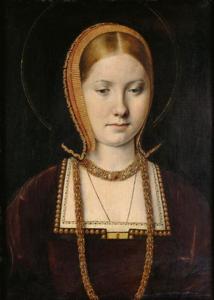
The English Gable Hood
 |
 |
Whatever one’s status – be it Queen, Gentle- or Working woman – headwear of some kind would be worn. Highly decorated as we have seen for the wealthy but simple linen coifs for those of lower status.
A Tudor Gown in the 16th century was the culmination of the work numerous skilled craftsmen, artisans and merchants. From the silk Merchant to the Weaver; from the Tailors to the Seamstresses to the Embroiderers and Milliners.
The finishing touches are made by the Goldsmith. Pearls and jewels in gold settings are worn as pendants attached to choker necklaces; as brooches on the front of a bodice; as billiaments on necklines and hoods and “ouches” on sleeves.
Truly, the Tudor Noblewoman was exquisitely dressed.
References
Mikhaila, Ninya and Malcolm-Davies, Jane. The Tudor Tailor: Reconstructing Sixteenth Century Dress London: Batsford, 2006.
Mikhaila, Ninya, Johnson, Caroline and Malcolm-Davies, Jane. ‘And her black satin gown must be new-bodied’: The Twenty-First-Century Body in Pursuit of the Holbein Look. Costume, vol 42, 2008 (The Costume Society).
Hayward, Maria. Dress at the Court of King Henry VIII, Leeds: Maney, 2007.
Hayward, Maria. Rich Apparel: Clothing and the Law in Henry VIII’s England, Farnham, Surrey: Ashgate, 2009.
‘Henry VIII: September 1531, 1-30’, Letters and Papers, Foreign and Domestic, Henry VIII, Volume 5: 1531-1532 (1880), pp. 199-217. Find online at http://www.british-history.ac.uk/
I saw a fantastic demonstration at Hampton Court Palace last November which talked in detail about the layers of clothing women wore during this period. VERY interesting and they showed some beautiful pieces of clothing!
I would love to possess a complete outfit but particularly a French hood and a table hood
ME TOO!!!!
What a wonderful post. I love clothes and learning more about what The Tudors actually worse as opposed to what they wear on The Tudors is fantastic. Thanks for the lovely list of reference books.
So. I am having a Tudor-esque wedding.I’m not going full blown traditional,but I want the feel of it.Does anyone have any resources on what their weddings were like? Kris is making my dress,but I wonder about other stuff,like what flowers they preferred,what an invitation would have looked like,etc. Any helpful hints would be much appreciated! My email is heirofartemis@yahoo.com Thanks all!
Di
wonder what they wore for let’s just say “panties?”
I would just like to say how much I enjoy everything you print about this fantastic era in history…still wondering what they wore for “panties” if anything?? Also….obviously there were no deodorants back then…so their clothing must have gotten ruined quickly..did they re-use these fabrics? Tear the gowns down & rebuild them? All those jewels that were sewn into these clothes had to be re-used.???
Thank you!
Tudor women did not wear knickers or bras, their underwear consisted of a linen smock and a woman would own enough smocks to last her a week. Heavy gowns could not be washed, and were beaten, so smocks were the pieces of an outfit that could be washed and they protected gowns from sweat and skin oils. Contrary to what some people say, Tudor people did wash their faces and bodies, and they also washed their smocks. They may not have had baths or showers (Henry VIII actually did have plumbed in bathrooms at Hampton Court Palace and Whitehall) but they did have tubs that they could use for washing and their smocks/chemises were made of linen so that they could be washed regularly. There were recipes for scented toilet soap and scented washing water which could be used for general bathing and also for washing hands at meal times between courses. Gervase Marham’s book from 1615 contains recipes for scented water, perfumed gloves, “to perfume a jerkin”, scented washing balls, musk balls, perfumes to burn, pomanders, “sweet bags” and “sweet water”. It is a wonderful book and can be ordered from Amazon – “The English Housewife”.
Jewels could be pinned to clothes and therefore easily re-used and swapped between outfits.
Obviously menstruation was an issue. Mikhaila and Malcolm-Davies, authors of The Tudor Tailor, write of how the use of menstruous cloths is mentioned in 16th century translations of the Bible. I found this in the King James Bible:
“ Ye shall defile also the covering of thy graven images of silver, and the ornament of thy molten images of gold: thou shalt cast them away as a menstruous cloth” Isaiah 30:22
and Elizabeth I’s household accounts included “vallopes all of fine hollande clothe” listed by the dozen. These wallops or rags may well have been used as sanitary pads or tampons, and the following description for three girdles for Elizabeth I may have been a sanitary belt to hold the rag in place:
“gyrdelles of blak Jeane silk made on the fingers garnished with buckelles hookes & eyes whipped over with silke” p24 Tudor Tailor
In “Blood, Bodies and Families”, Patricia Crawford writes of how remedies for menstrual problems included the use of pessaries – shorn wool steeped in mixtures or linen or silk bags containing herbs – with strings attached for removal, so Tudor women may also have used such pessaries, as well as cloth pads, to cope with periods. These pessaries could have been the fore-runner of the modern tampon.
I saw a TV Program on the history of English clothing that in the 18 century ladies did NOT wear ” panties!!!! That all came later
while in the late Medieval period it was less common to wash often, and for those of lower rank even into the Tudor period, but for all of Henry VII’s issues he was at the forefront of the movement to discredit the idea that submerging one’s self in water was unhealthy. He was rather obsessed with cleanliness, especially for the women with whom he was having relations. He and his family were also known to have aversions to bad breath and not taking care of oral health. His sister Queen Mary of France, later the Duchess of Suffolk was recorded as having three sets of tooth brushes and picks and to have the straitest and whitest teeth at the court. Women who were brought to the King’s bed (and in reality there was probably a lot fewer of them than shows like The Tudor’s would have one to believe) were expected to wash and freshen themselves before, especially in the v*ginal region.
He also subscribed to the idea that uncleanliness and vermin (from rats to flees and the like) were the carriers of disease, not just “evil humor” that traveled on the wind or anything as ludicrous. When his son was born he stipulated that everything in the nursery was to be cleaned daily and that even his walls were to be washed three times a day so that nothing could grow and fester to make him sick. He also very rarely aloud his young son to come to court for fear that he would catch something “contagious” and the idea that sickness spread from person to person not by supernatural means or whatever, but it is the beginning of the idea that small things growing, later viruses or bacteria were the causes and could be passed by bodily contact, breath, or bodily fluids. Whenever an outbreak of sickness was reported in the cities Henry immediately fled the city regions that were highly populated and near the festering river that was known to cause sickness in the warmer months for the safer country settings, limiting the amount of courtiers and servants that were aloud to accompany him for fear of carrying along the contagion with the groups of people.
So contrary to popular belief that people of the period were never to bathe and believed it unhealthy is unfounded at least among the upper classes who did put quite a bit of stock in keeping clean, smelling nice, and reducing flees and pests. People of lower rank and the working class would not have been able to bathe completely as often as those in the palaces because they would not have had running water in their living quarters nor would they have had the luxury to waste as much time in such pastimes as those of the leisure class.
also on interesting notes is that the flushing toilette was first invented and added to a Royal Palace in Queen Elizabeth I’s reign by one of her godsons. She thought it was a bit ridiculous and not very likely to catch on because it was suck a noisy contraption when flushed thus announcing a “royal flush” to everyone in the nearby court, but it did reduce the amount of stench around a stole closet and probably flies and such the warmer months.
Interesting article. For those interested in dress at the Henrician court with specific reference to Anne Boleyn, I recommend an MA thesis by Helen Persson – ‘“Mademoiselle de Boulan & Mrs Semel”, The Question of French Apparel and Dress Terminology in England of the 1530s’ (Courtauld Institute of Art, 1999).
Can I be really cheeky and ‘plug’ a short blog post I made on Mary Tudor and fashion? Anne Boleyn is mentioned in parts:
http://www.scribd.com/doc/30947190/She
LOVE this article! I wish we lived in an age where women wore more elegant clothes. I love the feminine look of Tudor dresses, especially the necklines. I live in jeans, t-shirts, and shorts like most southern Californians, but it sure would be fun to walk into Starbucks dressed up like a Tudor.
there is really no reason why you cant dress more “feminine” or in dresses of your own choosing today. i used to live in jeans and tees myself, but now all i own are dresses, of different styles colors, whatever, lace stockings are the only leg coverings i have, in all different colors and styles, i generally wear my hair up in intricate fashions with many jeweled hair pins, clips, and barrettes. You could too if you want. Actually the fact that we can wear whatever we want to wherever we want (within a pretty wide range of reason, obviously you cant wear flip flops to a fancy restaurant for the most part still) we live in a time where that is completely unprecedented for freedom of fashion. We have no sumptuary laws so even the lowest ranking among us can wear any pattern, color, or type of material. Southern California is firmly located in the “free” western world so there are no religious restrictions on what you wear, how much of you is covered for the most part, or any strict style requiring you to conform too as it had been at any other time in history. Until around thirty years ago companies and schools could still require women to wear skirts that had to be at least as long as their arms held firmly to their sides fingertips. Now you can pretty much dress as feminine or as butch as you want and in any type of clothing you want. So stop dreaming about “days of yore” cuz more than likely if you did live in tudor times you would be among the common working people and restricted from dressing like court ladies by sumptuary laws, religious reasons, the fact that all you can afford to wear is the same homespun sack from the day you get it till it falls completely apart and is always covered in flees and you wouldnt be bothered to care anyways because you are busy working, bearing and burying you children, and getting beaten by your cheating husband from the time you wake up pre-dawn to the time you fall into that ashpile in front of the fire to sleep at night, that is assuming you would be well enough off enough to be able to afford a fire for sleeping in front of (and remember Tudor times in England was during a “little ice age” when it was much colder in England, during the winters the Thames was often frozen over enough that it turned into an ice roadway for sleighs, horses, and even had stands for selling goods set up on it)
Stop dreaming and get out there and dress how you want now!! Take femininity back if you want and dress in whatever dresses you fancy unrestricted by stanch fashion requirements by age, status, city/country of origin and enjoy it.
Yes!!! Everything you just said!
Why on earth come in and tell people how to dress and to stop dreaming. Who cares what a person’s fantasy is?
It is better to REALIZE one’s dreams (fantasies), than to yearn uselessly for a thing, not understanding it is within your grasp! This advice is for Robin, who cackled like a hen just because Lisaannejane encouraged action!
Sarah, I am intrigued by your post as to what is in your closet. I have been in sweats, jeans & t-shirts as far back as I can remember. Please look for me on Facebook or email me. I have no clue how to even begin dressing as a woman of femininity. Any ideas would be appreciated to get me out of a grunge.
Tricia G H/ Tricia Gilbert Hinkle
Aktruckngal@gmail.com
I live in Southern California as well, lisannejane. From mid-July to late September, when it can get above 100 degrees Fahrenheit (or around 40 degrees Celsius), it would be impractical to dress in as many layers as a lady of the Tudor court. I suppose they could get away with it because it was a Little Ice Age and average temperatures were much cooler than today — not to mention the difference in climate between England and California 🙂
But isn’t it nice to dream of going to Starbucks or to the library or to the grocery store or to church dressed up like a Tudor lady and nobody batting an eye!
Not necessarily as a tudor lady, but you can still toss the t-shirts in favor of pretty corset like tops (minus boning, ’cause, ouch) with linen skirts or gypsy skirts and still be cool.
I forgot about the mini ice age, Gentillylace! There was a fascinating show on the history channel about this. Layering up on clothes probably had a practical purpose as well in Tudor times. However, if we go to San Francisco in the winter, I’ll bet we wouldn’t be too warm LOL! As Mark Twain said, the coldest winter he ever spent was a summer in San Francisco.
It cools down in most places over night as well. Especially in the high desert and near the ocean. I grew uo in Silicon Valley. Expensive too.
I miss the weather now that I live in Tennessee where its hot, humid, and 90° even at 3am. However , I’m eternally grateful to the inventor of air conditioning and that I don’t have to wear a corset, crinoline, and petticoats!
This is fabulous timing. I’ve just begun research on Tudor dress in preparation for creating an Anne Boleyn gown and look what link travels to my inbox! It won’t be 100% accurate with all four layers, but I’m trying to incorporate as much of the look and feel of a traditional royal gown as my skills (and budget) allow.
One of the more interesting pieces of information I’ve recently come across was that the front of bodice was actually pinned on. In the portrait of Jane Seymour, for example, you can see the little gold heads of the pins lining the sides. Can you imagine being pinned into your clothing each day?
The Sumptuary Laws, which were not new to Henry’s court but more strictly enforced, are also a cause of amazement. They outlined which ranks could were which fabrics, colors, and furs in which articles of clothing. Ah, Tudors, you never cease to bring me random tidbits of joy.
Great article! I’m having a Tudor dress made (1540’s era) and have thus far, the shift. We are trying to figure out what to use for the whalebone but have not yet got that far. I can’t wait to select the materials for the gown and get the fancy jewels sewn in. But, ti’s a big project and my friend, the seamstress, is having fun with it. I might even wear it to give readings when my book comes out!! Fun!!
To Anne Barhill.
Whalebone wasn’t used for stiffening bodices in the 16th Century. It is likely that most bodices were simply interlined with stiff buckram and then fitted very closely. However, when one start to move into the 1540s and the waistline becomes extended into a deep “V” then boning of some kind is needed to prevent the point of the waist to ‘flip up’. It is likely that cane or reed was used for boning. Perhaps a wooden busk could also be used to stiffen the front.
I would recommend using split cane or use the Wiesner plastic boning which is an “artificial” whalebone. It comes in various widths – 1/4 inch width would replicate the cane method very well.
Anne, I have a waist cincher which definitely has some very stiff pieces of fabric and probably metal as well to hold you in. Maidenform in the U.S. carries them but now you can get one at Target (the poor people’ s store) for as little as $15. Perhaps you could order one and find out what is being used. I think it would work in a Tudor gown. I have had one waist cincher for 3 years and it’s still going strong LOL!
Thanks guys–I’ve re-read this now that I have all the undergarments–next, material for the outer gown. I am finally beginning to ‘get the order and pieces, etc. Bess, here’s a question for you–I read somewhere that there is such a thing as a placket, an opening inthe smock. Do you know anything about this?
A placket is a means of fastening a skirt or bodice by means of an overlap . If you send me an e-mail address, I’ll draw one and send it. Not before the weekend.
wow there is alot of info here thanx for helping me with my homework. i got alot of cool stuff about it! xx :-]
whats the thing that rich women wear around their necks?
I have had a “itch” to sew a “real” Tudor gown for several years but arthritic hands have convinced me that it would be better to find a talented seamtress. Years ago when searching for a Halloween costume I found a “Tudor” gown; it is burgundy and royal blue, very pretty and even has slashed sleeves but the skirt is only a mock of the real thing. It is only looks layered with a royal blue panel sewed in front to give the impression of an underskirt. But over the years I have had such fun with it on Halloween and a few months ago I added a French hood to finish the “look”. Since mine is not layerd, I can only say I have no idea – Little Ice Age or no – how these strong women stood wearing so much each day! When I add a cape to it, I almost perish from warmth even in winter. I’m afraid if I had lived during Tudor times, I would have been arrested for exposing myself because it would only take one good heat wave and I would have been ripping everything off! I just don’t see how they could have been comfortable but then when it’s the normal thing to do prehaps you become immune to it.
Happy Holidays to everyone and especially Claire and her family.
I live in Michigan and the weather’s been so cold lately I think full on Tudor garb would be rather nice!
When I went to the Metropolitan Museum of Art’s show on actual Royal garments, I was addicted. The gowns were so spectacular, you just had to stare. Like many of you, it defies belief how these women were able to wear all the required clothing, because they were TINY. Catherine The Great’s wedding gown weighed 70 pounds and she was under 5 feet tall !!!!
I also wonder how they cleaned these gowns ? I recently watched a show describing the use of Nicotine to clean these gowns. The only problem is that Nicotine is poisonous and can kill a person in a very short time if it gets on the skin.
Does anyone know how cleaning was accomplished ?
Thanks
Allison
If there was a small stain, it could have been sponged off. The outer layer was brushed (the brushes looked like shaving brushes), but the lining was hand-washed.
Hope this helped.
Fascinating article, I am an operatic soprano and have worn costume from this period. I must say the French hood is very flattering and I wish it was currently in use!
No worries about bad hair days………but would the French government ban it with their recent legislation?
Now do forgive me, I understand that saying such things even today is considered uncouth and such. But could you please tell me about the short lived (i guess only because I have yet to find it on portraits) fashion of showing ones breasts in gowns? I seemed to have been wide spread long enough for even peasants to join in. I learned this years ago from a source i cant recall, but now that I try to find it again people on wikipidia and a few other sites write as if it never happened. But there are still a few sites that do reference it, so I am becoming more assured I am not just making it up. So yes , again, do you know anything about this or any places or books i might reference on the subject?
Very interesting article! Must have been difficult to wear so many layers of clothing and corsets most of the time.
Did ladies always wear a black veil or hairnet together with the hood? In the Tudors they often have the hair loose. Was this only customary for weddings?
omg this is all so wsome
Hey, I absolutely love this post…. I’m very interested in the fashion styles of Anne Boleyn, so if anyone here has some good online books or websites, could you please tell me?
I truly loved reading your post about tudor dress. I was not knowing all this. We are customising a tudor dress with embroidery detailing. I was very eager to know where the origin is.
Very informational.
What type of material was used in the picture of the mauve kirtle?
COOL!!!!!!
What a fascinating and hugely informative website! I live in Portsmouth in the UK and I`m a part-time volunteer guide at the Mary Rose Museum here in the Historic Dockyard. The museum houses the remains of Henry VIII`s flagship Mary Rose which sank in the Solent just off Southsea Castle in 1545 and over 19,000 artefacts from the ship which have been conserved and are on display. I am about to make myself an `authentic` Tudor outfit in mid green velvet and gold brocade to wear when I`m on duty, which is how I came across this site in my research for authenticity. But I`ve learned a lot more from the many comments you have made, which I can use when visitors ask questions. So thank you all .very much
Great post!
I’m thinking of going as the ghost of Anne Boleyn for next Halloween. Trust me, with my cruddy sewing skills, I’ll need over a year, plus a miracle. Along with a bottle of wine and a first air kit handy. Maybe even 911 on speed dial.
But seriously, this post is giving me a few ideas.
I’ve been reading CJ Sansom’s novels, set in the Tudor period and this post has really brought them to life. Thank you!
One thing I have not been able to find: What’s a linen hood tappet?
Would it be a “lappet” rather than tappet? The lappets are the side hanging pieces of the hood – the pieces you can see hanging down and almost touching her collarbone on Catherine in the image at http://image.wikifoundry.com/image/1/bqcyPNgTfiqxJLa18kg2qg49353/GW217H222
Only royals were allowed to wear ermine therefore that is not a portrait of a
Mary Boleyn as she was not even remotely considered of royal blood. That portrait has been wrongfully acknowledged for many years as any historian will tell you. Many people still argue it is Mary but they would be wrong. Check your facts concerning who was allowed to wear ermine during this time. The argument continues to this day.
Actually, that’s not true. Although Alison Weir noted that the sitter was unlikely to be Mary Boleyn because it was a “fur reserved exclusively for royalty and peers of the realm” it is not actually true and there are other portraits of noblewomen, such as Lady Vaux, wearing it. As Susan Higginbotham notes in a comment on her blog post on the subject at http://www.susanhigginbotham.com/blog/posts/mary-boleyn-or-frances-brandon/ that “the sumptuary legislation from Edward IV’s 1463 Parliament reads, “And also to ordain and decree that no esquire or gentleman, or anyone else below the degree of knight, or their wives, except the sons of lords and their wives, the daughters of lords, esquires for your body and their wives, shall use or wear, from the said feast [of the Purification of Our Lady next], any velvet, satin brocade, or any cloth of silk simulating them, or any bands made to imitate velvet or satin brocade, or any fur of ermine, on pain of forfeiting 10 marks to your said highness for every offence. . . . Provided always that the steward, chamberlain, treasurer and controller of your honourable household, and the carvers and knights for your body, and their wives, may use and wear furs of sable and ermine.”” So if that law still applied, which it appears to have done, then as a wife of an esquire of the body Mary would have been entitled to have worn ermine. Then there’s her family’s status, her father being Viscount Rochford at the time.
Still disagree to a certain degree. We will never really have verification on who that portrait is. I understand what her title and rank were but in Henry VIII court he made his own rules and didn’t follow protocol if it didn’t suit him. Lol. I still don’t think it was Mary Boleyn but we will unfortunately never know. The battle goes on as to who this portrait really is. I find it fascinating and I wish I could have been a fly on the wall during Tudor years. On another note, did you ever notice how the portraits of Ann Boleyn look completely different. Why is that?
A friend of mine Bess Chilver is a costume expert and re-enactor who has put in a vast amount of research into the sumptuary laws and clothing of the time and you can see her comment in that thread, but here it is now:
“As you say, ermine is not restricted to just the royal family by law at all. In addition, many people would make their own “ermine” by using cheaper white rabbit fur or another cheaper white fur and simply using ermine tailes to make it look like ermine. In fact, the ermine lining for most peers robes tends not to actually be ermine.”
She definitely knows her stuff.
Re the portraits of Anne, it may be down to the various artists’ style or it may be because they were painting them from memory or from different lost originals. None of them are contemporary, the only definite contemporary images we have are the 1534 medal, the cartoon-like sketch from her coronation plan and possible the image from the Black Book of the Garter. Holbein is said to have painted her and a full-length portrait was said to still be in existence in the 1700s, but we don’t have anything else to go on. It’s the same with lots of portraits, if you put the same person side by side you end up thinking that some of the artists really weren’t very good at capturing a likeness! I think style and propaganda was more important than capturing a true likeness.
Re: discussion of royals only being allowed to wear ermine. Wasn’t Lady Vaux descended from royal blood through Neville line or FitzAllen line which is what I had thought and that why she was wearing ermine in her portrait. I will stop beating a dead horse and get off that subject now. If anyone else can contribute information I would love your input. I enjoy this post. Thanks.
So after doing some research I read that it was only during Edward III reign that wearing ermine was restricted to royal family and after that they indeed used tails that were sewn into the fabric to replicate ermine and could be worn by people who were not royal. Thank you for help on costumes etc. I just love the web site for Bess Chilver. Gorgeous.
Bess’s costumes are incredible. I really must go to Kentwell Hall one summer and see the re-enactors there, they do a wonderful job.
Thank you so much for this post, I am making a Tudor gown for myself and my daughter for an upcoming event and found it most informative!! I have been wanting to make one for years but didn’t have it in the budget till now. I had been having so much fun making these gowns and I can’t wait to wear them next weekend.
what were the smock made from? for both the rice and the poor
They were made from linen, which was breathable and good to have close to the skin, but also easy to wash and dry, and long-lasting.
thanks
what were the Forepart and Foresleeves made from?
were they sperate from the rest of the dress then?
by the way I love your website, it’s been a great help for me with writing my essay on Tudor lady clothes.
Yes, foresleeves were separate and were tied to the gown’s sleeves, meaning that they could be used with different outfits. A forepart was a decorate v-shaped panel that was often sewn onto a petticoat. It was designed to peep out of the front of the overskirt. You can see a photo of one at https://i.pinimg.com/236x/7a/ab/cd/7aabcd59c2ccec035c0309aaea1173f9–tudor-dress-th-century.jpg. If you look at the portrait of Princess Mary at https://magpiecostumer.files.wordpress.com/2012/11/blackmary.jpeg, you can see that her foresleeves and forepart (or it could be simply her kirtle) match.
In Henry VIII’s inventory, which was an inventory of his possessions at his death, in the list I have of items linked to Anne Boleyn, there are sleeves of embroidered satin and embroidered cloth of gold. From the rest of his inventory, we know that sleeves could also be cloth of silver, tinsel, taffeta, tissue and velvet. Foreparts were made out of the same types of fabric.
Did sumptuary laws include the clergy? Could Wolsey wear ermine or sable? What about velvet and cloth of gold?
In relatively recent years the idea of how a french hood was constructed seems to have changed. It had once been generally assumed that it was simply a wired, stiffened crescent which sat aloft with a veil attached at the back. Some court portraits also showed a hint of a chin strap ( optional?) which would presumably have helped secure the piece into place.
Now however we frequently see video’s and illustrated guides revealing that there was apparently a concealed elongated piece attached under the hood which curved around the back ofthe head -under the veil-to hug the whole construction into position, more like a hat. Is this just a theory? How can anyone know for sure? Is there any evidence? It certainly makes the whole business of constructing a french hood far more time consuming and fiddly.
There were two waves of topless fashion.
I have seen in some sort of historical art,The Queen of England, one of the early Charles Stewart wives was topless….a wide European style, that few talk of. Don’t know if that was just one generation or not.
.Then there was the dresses deigned to pop out with any twist or deep breath time of Marie Antoinette, just before the single sheet of super thin gauze Empire clothing of 1790-1800. Became thicker after that and more and more covering. .
I’m writing a SF book where Lady Jane doesnt get executed; ending up Queen the second time. And no toplessness …. sadly.
This article is one of the clearest of Tudor era clothing.
From my reading, gowns would have been just for the noble or rich merchants and gentry and that more a Sunday dress for even well to do gentry.. .
Shift and petticoat would have been for peasants.
I’ve seen kirtle similar clothing on market women pictures from Flanders, open more like long duster than closed.
I have the impression a kirtle would have been more middle class like an innkeeper’s wife (they were middle class for three centuries or so) , and worn open often (as far as I can tell..) It helps to have maids, second cooks etc.
The the well chosen from powerful families, unpaid, (influence gifts are not wages nor are gifts from the Lady being waited on) Ladies in Waiting were, advisors, companions and part of their family’s gravy train,
Lady Blanche Perry, Elisabeth’s Lady in Waiting from she was a small child did very well for her self. A most charitable Lady to those in her properties giving near a ton of wheat each year to the needy in and around her properties. You could call her and the utterly brilliant Kat Ashley Elisabeth’s mothers. Lady Jane was as brilliant as Elisabeth. So many brilliant women then. Mildred Cecil and her sisters.
The real work was done by the servants; seamstresses, pinning or very lightly stitching arms on.
Thanks for the great article and some very good comments.
Hi.
I am Justyna from Poland. I need some help. I am amking a life project- wherever i go I want to make a photo in traditional outfits/ national clothes ect. I am going first time to London this March and I would like to dress up as well. The Tudor’s outif looks amaizing! Also I really like to watch periodic dramas. Do you have any ideas where I will be able to do that in London?
Thank you so much.
My daughter has been reading the books on the six wives of Henry the V111, and has taken an interest in their clothes. She has made a request, that for Christmas, she would like me to make her, six Barbie’s all dressed like his six wives..My hobby is making bride dresses for Barbies, and giving them to charity, and I make a lot of them, but this is going to be quite an undertaking. I have started doing the research, and would like to be as authentic as I can, using all the appropriate fabrics.Wish me luck on this project.
I would love to see a period drama of Henry the vlll era focusing around the making of the garments and the people who designed the clothes and the people who stitched them it fascinates me thinking about the fittings and the chat and gossip that would have been going on while they were working